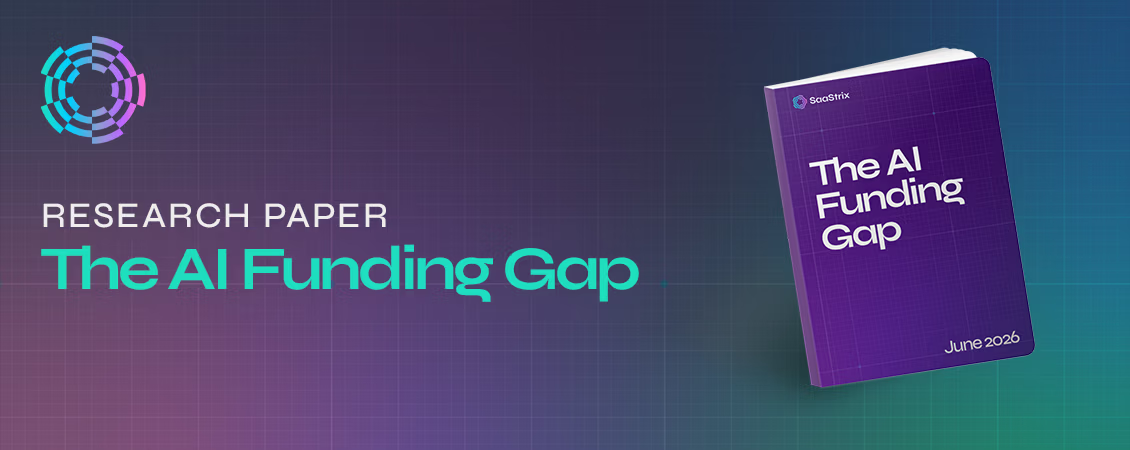
Most B2B SaaS marketers are now paying for at least some of their own AI tools out of their own pocket. That is the headline finding of The AI Funding Gap, a new SaaStrix study in which 739 engaged B2B SaaS marketers took part: 71% of those surveyed cover part of the cost themselves, and almost all of those (98%) spend more than £20 a month of their own money.
Their employers get the productivity. They get the bill.
One thing to be clear about before the rest of the numbers: 739 marketers took part in the study, 693 of them through a structured survey and the rest through focus groups and one-to-one interviews. Every headline percentage in this post comes from those 693 survey responses; the interviews supplied the quotes. And these are not marketers in general. Everyone who took part is a member of an AI-focused marketing community, which makes them the engaged, self-investing end of the profession, the people already taking their AI development seriously.
That self-selection is the reason the self-funding rates run so high, and it is the point rather than a flaw. Read these figures as the reality for committed B2B SaaS marketers who are setting the pace, not as a claim about everyone in the job.
We have published the full findings as The AI Funding Gap, part of our AI-Native Marketer Report 2026, and the name describes exactly what the data shows: the space between what B2B SaaS marketers are now expected to do with AI and what their employers are willing to fund to help them do it. The full paper sits inside the SaaStrix community for members. Here is what it found, and why it matters if you are the one living in that gap.
The ten findings that define the gap, all from the 693 survey responses:
The rest of this post walks through what sits behind those numbers.
Yes, and not occasionally. Among the 693 B2B SaaS marketers surveyed for The AI Funding Gap, 71% said they cover at least some of the cost of their work AI tools themselves.
Of those self-funders, 98% spend more than £20 a month of their own money, and a meaningful share spend well above that. Most of these tools bill in US dollars, so the exact figure moves a little each month, but the pattern does not: this is a workforce quietly subsidising its own productivity.
People do not spend their own money on tools they do not need. A marketing team expensing its own AI out of pocket is about the clearest evidence you can find that the tools deliver, and that employers are getting the upside for free while declining to fund it, govern it, or roll it out properly.
One marketer put it plainly in our interviews: "I'm paying for both Claude and ChatGPT every month. It's too much of a headache to get everything signed off all the time."
Because the expectation arrived before the support did. More than eight in ten of the marketers surveyed (84%) now use AI in their work every day, yet nearly nine in ten (88%) are allowed to use it with no real guidance on how, and three in four (74%) have no dedicated budget for AI learning.
The funding stops at development, too. More than two-thirds (68%) say their employer paid for none of the four things that build AI capability: not a course, not an event, not a community membership, not a training session. So marketers are filling that gap themselves, with eight in ten (81%) personally paying for at least one of those in the past year.
The instruction to produce AI-assisted work is now close to universal. The infrastructure to do it well is not.
Then it gets sharper, because access is being pulled back. Nearly half of the marketers surveyed (47%) have had an AI tool they relied on for work blocked, restricted or withdrawn, with no funded alternative put in its place. Separately, 43% have seen an AI or learning budget cut or frozen in the past year, and nearly a quarter of those (23%) were given no reason at all.
That leaves a marketer with three options: fall behind, break policy, or pay for it themselves. None of those is a strategy. All three are the predictable result of under-investment.
"One email and they told us we can't use it anymore. Yet the volume of work was still expected. So now I'm using my personal account on my own laptop, which I know I'm not really meant to be doing."
That was a B2B SaaS marketer describing, in our interviews, the position roughly half the sample now finds itself in.
The people paying for it. This is the finding that should sit least comfortably.
Among the B2B SaaS marketers in our sample whose employers fund everything, just 11% are seriously worried about keeping pace with AI. Among those paying their own way, that figure is 80%. Pay for your own AI and you are roughly seven times more likely to fear falling behind than a colleague whose employer funds it.
The self-funders are not the disengaged ones. They are the most invested and the most anxious. Their effort is buying the company productivity and buying themselves worry.
Confidence is low almost everywhere, too. Fewer than one in five of the marketers surveyed (19%) feel confident in their AI skills, and that holds fairly steady regardless of seniority or who pays. The skill gap is shared.
What is not shared is the fear. More than half (57%) say they personally know a marketer who lost a job in the past year where AI was cited or suspected as a factor. We treat that as perception rather than proof. It reflects what these marketers witness and believe, not a verified cause of any single redundancy. But perception drives behaviour, and the perception is now widespread.
The reward for carrying all this looks thin, too. 60% say their AI skills have brought them no career return at all: no pay rise, no promotion, no added responsibility, not even recognition.
It can certainly feel that way. We would argue it is closer to the opposite.
If you have been quietly funding your own tools and your own development, you are not behind the curve. You are ahead of your own employer, investing in the capability your career now depends on before the company got round to it.
The marketers getting ahead right now are not the ones with the most generous budgets. They are the ones who decided not to wait. The anxiety that comes with that is understandable, but the instinct behind it is the right one.
This is also what becoming an AI-native marketer actually looks like in practice: treating your AI capability as your own responsibility rather than waiting for permission. We have written about that shift separately in What Is an AI-Native Marketer? (And How to Become One), and the funding-gap data is the clearest evidence yet that the marketers already living it are the ones setting the pace. If you want the practical side, our field guide AI in Marketing: A B2B SaaS Marketer's Field Guide (16 Real Use Cases for 2026) covers what that work looks like day to day.
The AI funding gap is real, it is widespread, and for now it is yours to manage. Waiting for your employer to close it is the slow path, and the evidence says most employers are not moving.
The good news in the data is that the people closing the gap themselves are not the ones with the biggest budgets. They are the ones who started.
This research is the what and the why. The how, the actual workflows for closing your own funding gap, is what the community is built for. SaaStrix is the AI-native marketing community for B2B marketers: the applied workflows, the short focused sessions, the library of how strong brands are really using AI, and a room full of marketers working the same problem with an operator's judgement to steer by, so you are not guessing your way through it on your own.
If you recognised yourself in these numbers, you have already done the thing most marketers have not. The 5-day free trial gets you the full AI Funding Gap paper, and the member discussion running alongside it right now, where CMOs and working marketers are comparing notes on what the gap looks like inside their companies and which budget arguments actually land.
No rush. The gap will still be there, and so will the room of people closing it.
What is the AI funding gap?
The AI funding gap is the space between what B2B SaaS marketers are now expected to do with AI and what their employers are willing to fund to help them do it. The term comes from The AI Funding Gap, a 2026 SaaStrix study of 739 B2B SaaS marketers in which 71% of those surveyed reported paying for at least some of their own work AI tools.
How many B2B SaaS marketers pay for their own AI tools?
In The AI Funding Gap, SaaStrix's 2026 study, 739 engaged B2B SaaS marketers took part and 71% of the 693 surveyed said they cover at least some of the cost of their work AI tools themselves. Of those self-funders, 98% spend more than £20 a month of their own money. The sample is the engaged, self-investing end of the profession, so read the figures as the reality for committed marketers setting the pace, not a claim about everyone in the job.
Where can I read the full AI Funding Gap paper?
The full AI Funding Gap paper is published inside the SaaStrix community, alongside a live member discussion of the findings. Membership starts with a 5-day free trial, which includes access to the paper and the discussion. This post carries the headline findings; the paper carries the full data, method and analysis.
Why are marketers funding their own AI?
Because the expectation arrived before the support did. More than eight in ten of those surveyed (84%) use AI daily, nearly nine in ten (88%) are allowed to use it with no real guidance, and more than two-thirds (68%) say their employer paid for none of the four things that build AI capability. Nearly half (47%) have had a tool they relied on blocked or withdrawn with no funded alternative.
Are self-funding marketers more worried about keeping up with AI?
Markedly so. Among marketers whose employers fund everything, 11% are seriously worried about keeping pace; among those paying their own way, the figure is 80%, roughly seven times higher. The self-funders are the most invested and the most anxious at the same time.
Is paying for your own AI a sign you are falling behind?
It can feel that way, but the evidence points the other way. If you have been funding your own tools and development, you are ahead of your own employer, investing in the capability your career now depends on before the company got round to it. The marketers getting ahead are not the ones with the biggest budgets; they are the ones who decided not to wait.
SaaStrix is where B2B marketers become agentic marketing leaders, and you can try it free for five days.


.svg)