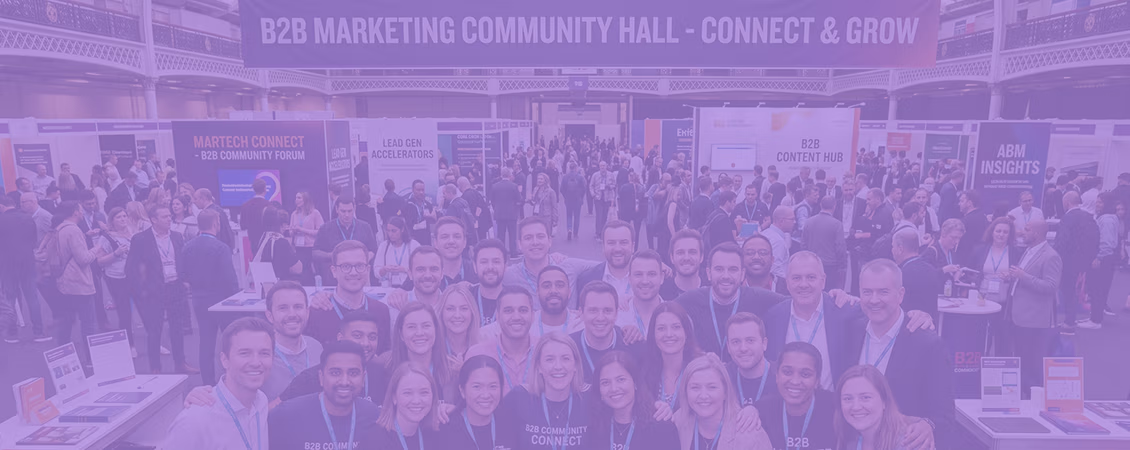
A B2B marketing community is a room of practising marketers who answer each other's questions. The useful test is not what the operator calls it, but whether members would still get value from one another if the host stopped publishing for a month.
SaaStrix is one. So are Pavilion, RevGenius, Superpath and The Marketing Meetup, and they work in very different ways.
This guide covers what separates a community from an audience, which types exist, what peer knowledge gives you that published content cannot, what a well-run community looks like from the inside, and the four things worth checking before you pay for anything.
One quick clarification. The phrase "B2B marketing community" is used two ways. Marketers use it to mean a peer group they might join. Software vendors use it to mean a customer community a company builds as a marketing channel, which is a different job with different economics.
If you arrived here looking for the second thing, the short version is that brand-owned customer communities are built to reduce support costs, deepen product adoption and create advocates, and platforms like Higher Logic, Gainsight and Circle all publish detailed guidance on running one. The rest of this page is about the first thing: finding a room worth being in.
The clearest definition available comes from Etienne Wenger, Richard McDermott and William Snyder, whose 2002 book Cultivating Communities of Practice describes a community of practice as a group of people who share a concern or a set of problems about a topic, and who deepen their knowledge by interacting on an ongoing basis.
Three things carry that definition:
Applied to B2B marketing, that gives you a workable test. A newsletter has a shared domain and no member interaction, which makes it an audience. A Slack workspace is infrastructure, not a community, until members recognise one another and expect to be answered.
A course has interaction but a fixed endpoint and a curriculum the host controls. A professional association adds standards or credentials on top. A mastermind is a community deliberately kept small enough that everyone knows everyone.
Most real products sit across those lines. Plenty of communities run courses, and plenty of courses have a chat channel bolted on. The category label on the sales page tells you less than the structure underneath it.
The distinction that holds up is the direction the value travels.
In an audience, the host produces and members consume. Value flows one way, and the size of the audience is the whole point. In a community, members produce value for each other, and the host's job shifts from performing to convening.
That is why the month-without-the-host test works: an audience goes quiet when the host stops, and a community does not.
Lave and Wenger's Situated Learning (1991) explains the mechanism. They describe legitimate peripheral participation: newcomers start at the edge, watching how experienced practitioners frame problems and what they treat as relevant, then move inward over time. Learning happens by becoming a participant rather than by receiving information.
Their phrasing is worth keeping, because it names something a course cannot do. The newcomer's task is not to learn from talk. It is to learn to talk.
A broadcast channel has no periphery to move in from. There is one producer and an undifferentiated audience, and no path between them. Wenger's later work with Beverly Wenger-Trayner describes healthy communities as having core, active and peripheral participants rather than assuming everyone contributes equally, which is a more realistic picture than any membership number.
Less than people assume. Threaded, searchable platforms preserve conversations that keep their value for months, while chat-first platforms reward speed and lose things quickly. Both work.
What matters is whether the operator chose deliberately and built rituals to suit, or simply defaulted to whatever was cheapest.
Six models cover almost everything in the category, and the model tells you more about what you will get than the branding does.
Independent paid communities sell access and programming directly to members. SaaStrix sits here at £29.95 per month or £299.95 per year, as does Superpath, founded by Jimmy Daly in May 2020 for content marketers. These live or die on whether members find the fee worth renewing, which is a useful incentive because it forces continuous justification of both cost and attention.
Tiered peer networks with local chapters combine an online membership with in-person events organised by city. Pavilion is the clearest example, reporting more than 10,000 members with around 70% at VP level or above, and it is priced accordingly. Members frequently expense it through employer learning and development budgets.
Free open communities monetise through sponsorship, recruitment, events or an adjacent product rather than membership fees. RevGenius, founded by Jared Robin in 2020, reports over 50,000 members across sales, marketing, revenue operations and customer success. Online Geniuses is a large free Slack community for digital marketers.
Association and chapter models run on events, dues and local leadership. The Marketing Meetup, founded in Cambridge in 2016 by Joe Glover, runs events on a pay-what-you-choose basis, typically between £5 and £50, rather than charging a single membership fee.
Cohort-plus-community businesses sell structured learning with alumni access attached. Reforge is the best-known, with more than 100,000 alumni, and its acquisition by Miro on 24 March 2026 is the clearest recent evidence that education and community assets are consolidating into software platforms.
Vendor-owned communities are built by a software company around its own product. Salesforce's Trailblazer groups are the largest example in B2B, with individual topic groups above 100,000 members. These are genuinely useful for product-specific problems and structurally limited for anything else, because the vendor is in the room.
Treat every figure above as order-of-magnitude rather than audited. Operators define "member" differently, and almost none publish monthly active numbers. Online Geniuses currently cites 25,000, 35,000 vetted, and 53,000 experts in different places on its own site.
That is not necessarily dishonest, since those may be different denominators, but it does mean the number on a sales page is the least reliable data point available to you.
Two things, and the second is the one people underestimate.
The first is tacit knowledge. Michael Polanyi coined the term in The Tacit Dimension (1966) to describe what we know but cannot fully articulate. Ikujiro Nonaka's work on organisational knowledge creation (Organization Science, 1994) established how it moves: through joint activity, observation and dialogue rather than through documentation.
You cannot write down the judgement that tells an experienced marketer which parts of a brief to ignore, because the person holding it often could not tell you either.
There is a striking piece of evidence for how far this goes. John Gabbay and Andrée le May's ethnographic study of GPs, published in the BMJ in 2004, found that clinicians did not primarily use published evidence-based guidelines. They used what the authors called "mindlines": internalised, collectively reinforced guidelines built through conversation with colleagues and trusted sources.
Even in a profession with an unusually strong formal evidence base, socially transmitted knowledge won. Marketing's formal evidence base is considerably weaker.
The second is information that carries a cost to publishing: compensation figures, real budget allocations, which agency actually delivered and which one burned six months, and what a vendor's implementation genuinely involved rather than what the case study says. The person who knows is usually constrained from saying so publicly. That is a structural reason a private room can hold information no article can, independent of anything an operator claims about it.
Solo marketers and small teams, because the gap is specific and unfilled. A marketing manager who is the only marketer at a £3m ARR SaaS company has nobody internally to sanity-check a decision with. Their alternatives are an agency with an incentive to sell, a consultant on day rates, or a conference twice a year.
Worth being straight about the evidence here: we could not find independent survey research quantifying this for B2B marketers specifically. The structural logic is sound and the pattern is consistent across sources, but most published testimony on it comes from people who sell communities.
The intuitive answer is that it did not, and that AI assistants substitute for peers. The data points the other way, though not for the reason most people assume.
Start with what buyers report. SurveyMonkey and Reddit published The Hidden B2B Journey on 10 March 2026, covering 1,200 US business decision-makers. Peer recommendations came out as the most trusted information source at 73%.
Vendor websites scored 55%, search engines 54%, review sites 46%, AI chatbots 39% and social media 36%. The same study found 83% complete their research through peer communities and self-directed search before contacting a sales team. Reddit commissioned that research and sells the behaviour the findings endorse, so weigh it accordingly, though the direction is corroborated elsewhere.
TrustRadius's 2026 B2B Buying Disconnect report, covering 1,862 buyers, found 63% used AI during their purchase journey and 94% of those fact-check its output at least some of the time.
That second figure is the interesting one. AI has become the retrieval layer without becoming the trust layer. Something still has to perform verification, and what people reach for is human.
The open web became a less reliable route to specific, current information. The Pew Research Center tracked the browsing behaviour of 900 US adults across 68,879 Google searches in March 2025, publishing in July that year. Where an AI summary appeared, users clicked a traditional search result in 8% of visits, against 15% where no summary appeared.
Only 1% clicked a source cited inside the summary. Google disputed the methodology, arguing the analysis period overlapped with unrelated testing, and that objection is on the record. Other studies using different methods have found the same direction at different magnitudes.
For a marketer, the consequence is not the publisher story. It is that reaching current, specific, non-generic information increasingly means going direct rather than searching for it.
The Content Marketing Institute surveyed 644 full-time marketers in February 2026 for its 2026 Career and Salary Outlook. It found 76% doing the work of more than one job and 50% taking on new responsibilities without a promotion or pay rise, while only 11% of organisations had replaced workers with AI. One in three companies is reducing entry-level hiring, at roughly 2.5 times the rate of any reported increase, even though overall team growth remains positive.
CMI's Robert Rose calls the result a "ghost workforce".
CMI's own conclusion is worth quoting because it comes from an organisation with no community to sell. Managing director Stephanie Stahl said the report "underscores the urgent need for career development and community support to help marketers thrive in this evolving environment".
There is also causal evidence that networks matter for marketing careers specifically. Rajkumar and colleagues published "A causal test of the strength of weak ties" in Science on 16 September 2022, using randomised experiments on LinkedIn's recommendation algorithm across more than 20 million people over five years. Weak ties did cause increased job mobility, and the effect was strongest in the most digital industries.
B2B SaaS marketing sits at the high end of every dimension they measured.
Whether community participation itself has actually risen because of AI. We looked, and there is no study establishing it. Individual operators publish growth figures, and community professionals report adopting AI tools at scale, but neither measures members participating differently.
The honest position is that the case rests on mechanism and adjacent data rather than on direct measurement, which makes it a live question rather than a settled one.
Five practices separate the good ones, and the first has the strongest evidence behind it by some distance.
New members get answered. Blair Nonnecke's doctoral research in 2000 found lurking rates were significantly higher in communities that did not respond to new posters. Joyce and Kraut's newsgroup study, replicated repeatedly since, found newcomers who received a reply were around 12 percentage points more likely to post again. This compounds in both directions: unanswered first posts create lurkers, lurkers produce fewer answers, and fewer answers create more lurkers.
Members talk to members more than the host talks to everyone. No validated ratio exists, but the direction is not in dispute. A room where most replies come from staff is a support desk with a friendly tone.
Rituals create predictable openings. Recurring critique threads, benchmark exchanges, office hours and member-led sessions all give people a reason to show up that does not depend on someone feeling spontaneously chatty. CMX's 2024 industry survey found 47% of communities ran at least some member-led events.
Size is managed rather than maximised. Brian Butler's longitudinal study of online groups (Information Systems Research, 2001) established the tension precisely: more members bring more information and support, and also more communication volume and coordination cost. Past a certain point, growth makes a community worse. Which is why larger communities introduce zones, chapters or role-specific groups, so the working unit stays small enough that people recognise each other.
Moderation protects the purpose rather than the post count. Product Coalition closed its Slack community in 2025, publishing a candid explanation that the conversation had degenerated into link-dumping rather than discussion. That is a purpose failure rather than a traffic failure, and it is the more common way these rooms die.
Four checks, ordered by how much evidence sits behind them.
Ask what proportion of member questions get a substantive reply from another member, and how quickly. This is the only marker with a documented causal link to community health, per Nonnecke's finding above. If the operator does not measure it, that tells you something in itself.
Ask for the ratio of member-originated posts to host-originated posts. A community where the host writes most of the content is a publication with a comments section. Both can be worth paying for, but you should know which one you are buying.
Ask for active member figures rather than total registered members. Given how inconsistently the category defines "member", the reaction to this question is often more informative than the answer.
During any trial, post a real question of your own. Not a hello. An actual problem you are stuck on this week. This tests newcomer response directly rather than relying on anyone's account of it, and it is the single most useful thing a trial period is for.
What a trial cannot tell you: whether the community will still be good in a year, whether its most valuable contributors are about to leave, and whether your own participation will be enough to get anything out of it. That last one turns out to matter more than most buyers expect.
More than the sales page implies, and this is the most practically useful finding in the research.
Jenny Preece, Blair Nonnecke and Dorine Andrews published "The top five reasons for lurking" in Computers in Human Behavior in 2004. Their conclusion is counter-intuitive and worth carrying: most lurkers are not free-riders. The top five reasons people gave for not posting were that they did not need to, that they wanted to understand the group first, that they thought they were being helpful by not adding noise, that the software defeated them, and that they disliked the group's dynamics.
Two of those are actively pro-social.
The same body of work found lurkers were generally less positive about a community's benefits than posters, and less comfortable with their own lurking. Whether that is cause or effect is not established. But it means passive membership is associated with a worse experience, not simply a smaller one.
Read alongside Nonnecke's finding that communities which ignore newcomers produce more lurkers, this splits responsibility. Some of it is yours. Some of it is the room's design.
Which reframes the question you should be asking. Not "is this community good", which you cannot really assess from outside, but "will this community get me talking", which you can test directly in a five-day trial.
Our position, and it is a position rather than a finding: lurking is fine as a phase and corrosive as a permanent condition.
No established framework exists for valuing membership from the member's side. Every measurement model we found, including the ones community platforms publish, measures what a community returns to the organisation running it.
So here is one worth trying. Put the annual fee on one side, plus your realistic weekly hours priced at your own effective hourly rate. On the other side, count decisions you made better, vendor or agency mistakes you avoided, and opportunities or hires that came through the room.
Run it at 90 days rather than 30, because relationships do not compound that fast.
For scale: a single B2B marketing conference ticket plus travel typically exceeds the annual cost of most paid communities, and buys you concentrated access for two or three days rather than continuous access all year.
If you are early in this and want one room rather than five, start with a community that matches the work you are actually doing this year, and commit to posting in it weekly for three months.
SaaStrix is built for that. Daily peer discussion runs across four zones, Strategy, Operations, Content Marketing and Storytelling, so a positioning question and a workflow question do not land in the same undifferentiated feed. Founder Danny Asling holds a live Q&A every month and keeps a private inbox open for the one-to-one questions members would rather ask anonymously.
The Vault holds the templates and frameworks members reuse. Sprints run alongside the discussion as short courses, currently Copywriting for Marketers, Hooks, and Claude AI for Marketers. Membership costs £29.95 a month or £299.95 a year, there is a free five-day trial, and the room holds more than 2,000 paid members worldwide alongside a free weekly newsletter read by over 21,000 subscribers.
Since we published four checks above, it is only fair to answer them.
On newcomer response, every question posted gets at least one reply, and the average time to a first reply is around 60 minutes. That average hides real variance, and it is worth being straight about it. Members sit across UK and US time zones, so a question posted late on a UK evening waits longer than one posted mid-morning.
Mondays are busy and Sundays are quiet. Some questions come back in five minutes and some take most of a day.
On the member-to-host ratio, a single number would mislead you. In the discussion spaces it runs at roughly 90% member posts. In Sprints it is all us, because a member cannot create a Sprint.
Any community running structured content alongside open discussion has that same split, which is worth remembering if you ask another operator this question and get one tidy figure back.
On active members, we publish total membership rather than monthly active figures. That is what everyone else in the category does, and we are no better for it.
The fourth check is the one we would actually recommend you run. The free five-day trial exists so you can post something you are stuck on and see what comes back.
To compare specific options side by side, we have covered those separately in Best Marketing Communities for B2B Marketers in 2026. For AI specifically, The Best AI Marketing Communities for B2B Marketers covers that ground.
Not a course. Not a newsletter. A working community: Sprints, real workflows, and marketers who'll answer the question you're stuck on today.
You can join SaaStrix here.
What is a B2B marketing community?
A B2B marketing community is a group of practising B2B marketers who exchange help, benchmarks and experience with each other on an ongoing basis. It differs from a newsletter or a course because value flows between members rather than from a host to an audience. The practical test is whether members would still get value from one another if the host stopped publishing for a month.
What is the difference between a marketing community and a marketing newsletter?
A newsletter is a one-way channel: the publisher creates and subscribers consume. A community is many-to-many, where members answer each other's questions and build shared ways of working over time. Many communities also run a newsletter, but the newsletter is the front door rather than the room itself.
How much does a B2B marketing community cost?
Prices range from free to several thousand pounds a year. Free options include RevGenius and Online Geniuses. Independent paid communities typically sit between £25 and £45 per month, with SaaStrix at £29.95 per month or £299.95 per year.
Senior executive networks such as Pavilion sit considerably higher and are usually gated by application. For comparison, a single marketing conference ticket plus travel often costs more than a year of most paid communities.
Are B2B marketing communities worth it?
Far more depends on your participation than on the community itself. Preece, Nonnecke and Andrews found that members who post rate a community's benefits more highly than members who only read, and Nonnecke's earlier work found that communities answering newcomers quickly produce fewer lurkers. If you will realistically post weekly, a well-run community is one of the cheaper ways to access experience you cannot buy elsewhere.
If you will not, most of the value stays out of reach.
How do I know if a marketing community is any good before I pay?
Ask what proportion of member questions receive a substantive reply from another member and how quickly, ask for the ratio of member posts to host posts, and ask for active member numbers rather than total registrations. Then use any trial period to post a real question of your own and see what comes back. That last check tests the thing that matters most and cannot be faked by a sales page.
What is the best B2B marketing community for a solo marketer?
Solo marketers and small teams tend to get the most from communities, because they have no senior marketing peer internally to sanity-check decisions with. Look for a community with an active daily discussion habit, clear places to ask questions by topic, and members working at a similar company size to yours. Advice from a nine-person marketing team at a $50m ARR company often does not transfer to a one-person team, and the constraint that made it work is rarely stated.
SaaStrix is where B2B marketers become agentic marketing leaders, and you can try it free for five days.


.svg)