
The man who coined vibe coding retired the term in February 2026 and replaced it with something agentic. Vibe marketing, its derivative, is still sold to marketers as the future. Where the phrase came from, the four definitions now fighting over it, and what the evidence actually supports.
Vibe marketing is the practice of directing AI tools and agents to produce, test and run marketing work that used to take a team of specialists. That is one definition. Three others are in circulation, they contradict each other, and the man who coined the parent term walked away from it.
Andrej Karpathy posted “vibe coding” on X on 2 February 2025. A year later he declared it passé and proposed a replacement: agentic engineering.
Agentic, because the person is orchestrating agents rather than typing. Engineering, because there is craft and expertise in doing it well.
Vibe marketing borrowed his framing seven weeks after he coined it and kept going after he stopped. This page covers where the term came from, who is fighting over the definition, what the evidence says about whether the practice works, and whether the word belongs anywhere near your own.
It came from vibe coding, seven weeks later. Karpathy described a way of working where you give in to the vibes and stop reading the code. Greg Isenberg, an investor and founder, applied the idea to marketing in a post on X and LinkedIn on 22 March 2025, crediting James Dickerson as the person who showed him the workflows.
The phrase had been circulating in that network since February.
Isenberg's framing set the template every later explainer copies. Vibe coding had turned eight-week development cycles into two-day sprints, and the same 20x acceleration was, he said, hitting marketing teams.
A single marketer with AI agents replaces ten specialists. Campaigns launch in days rather than weeks.
Two days later a Forbes contributor article by Josipa Majic Predin carried the idea to a mainstream masthead. That article is where the “$250 billion industry” figure enters circulation.
Because it is repeated, not checked. Isenberg said the $250 billion marketing industry was about to change forever. Forbes traced the number to Statista's 2024 valuation of the marketing technology market.
Martech is not marketing. The global marketing industry is very much larger than its software category. The figure has since been copied across dozens of pages as though it described marketing as a whole, which makes it a useful diagnostic: if a page repeats it without the correction, that page did not check its source either.
There is a sharper example. Go Fractional, one of five pages Google's AI Overview currently cites for this term, quotes Predin's single-marketer line and credits it to Fast Company. She wrote it for Forbes.
We repeated the same error in our own research brief before catching it. When five vendor pages define a term for an answer engine and one of them misattributes its central quote, the citation layer is copying rather than verifying.
Four meanings are live, and at least three of them are incompatible.
The workflow definition is Isenberg's: one marketer plus agents, testing many angles, shipping fast. MarTech and the Forbes piece use it.
The emotional definition has nothing to do with AI. Salesforce defines vibe marketing as creating an emotion around a brand rather than explicitly promoting specific products. The Drum has run the term twice in 2026 and used it in this sense both times, with no AI workflow content at all.
The vendor definition folds the workflow into a specific product. Klaviyo's explainer routes into its own AI marketing agent.
The operating model definition is the most sophisticated. Hightouch argues that most versions of vibe marketing are really describing marketing automation, that speed alone is a multiplier rather than a strategy, and that the version which compounds needs customer data plus a brand context layer. Both of those are Hightouch products.
Almost everyone writing a definition sells something the definition flatters. Not an accusation of bad faith. It is a structural feature of how the term got documented: the pages explaining it are mostly pages selling into it.
Hightouch is the clearest case, and the detail that gives the whole argument away. It publishes a guide to vibe marketing. It also describes itself, on its homepage and in every job advert it runs, as “an Agentic Marketing Platform powered by the industry-leading Composable CDP.” Its product is literally named the Agentic Marketing Platform.
So a company writes explainers about vibe marketing while naming its own category agentic marketing. Whatever it expects to be saying in two years, it is not the word in the headline.
No. There is no analyst definition, no dictionary entry, no standards body, no Wikipedia article.
Gartner does not use the phrase. Its Hype Cycle for Digital Marketing, published 10 July 2026, frames the same shift as the move to autonomous marketing. Its agentic AI research uses agentic.
The vocabulary buyers encounter from analysts is agentic and autonomous, not vibe.
The closest thing to a neutral reference entry is an algorithmically generated trend page, which gives the emotional definition rather than the AI one.
The most credible mainstream coverage we found says so outright. eMarketer, writing on 25 November 2025, reported that marketing leaders have not settled on an exact definition while still expecting the thing itself to matter. A research publisher conceded the core problem ten months ago, and nothing since has resolved it.
Yes, at the margins, and the postings prove the confusion rather than the category.
Revamp, a Y Combinator company, advertises a part-time fractional Vibe Marketer. Read the description and it is a culture-first social role: spot cultural moments, translate them into posts for LinkedIn, X and TikTok, keep the website fresh. The advert says explicitly it is not looking for a social media manager or a corporate copywriter.
There is no AI workflow in it.
Sendbird, on the same job board, advertises an AI-First Full Stack Marketer. That advert asks for experience with Claude Code, Cursor, Replit and Lovable, which it calls “vibe coding tools,” plus Runway and Midjourney. It is the workflow profile exactly.
It is full time and senior. It does not use the word vibe in the title.
The widely repeated claim that a startup offered a seven-figure package for a vibe marketer traces to a job posting that now returns a 404. Nobody quoted the salary in text before it disappeared.
The pattern: the practice is being hired for. The label mostly is not.
There is no dated, named, method-described case of a single marketer producing the claimed outcomes under this label that survives a sourcing check. We looked hard. Every named company example in circulation traces either to a vendor case study about a different practice, or to nothing at all.
What can be stood up is narrower. Recorded demonstrations exist in which one person builds research, positioning, copy, a landing page and ad creative inside a single session. Those show the workflow is executable by one person.
They are not evidence of outcomes, because the demonstrations are built for invented companies.
The general shift is real and measurable. Exploding Topics surveyed 1,008 US marketing budget decision-makers and published the results on 1 April 2026, finding AI adoption at scale and roughly 42% of marketers saying AI had increased their budget. The survey does not call it vibe marketing.
Stronger than the evidence for, and it comes from three directions.
Teams are getting bigger, not smaller. In that same April 2026 survey, 60.12% of marketing teams had expanded headcount over the previous twelve months and 8.9% had reduced it. The teams investing most heavily in AI were the ones hiring most.
The publisher's own reading is that marketing tools are being replaced but marketers are not. It is also the publisher whose search-growth figure anchors nearly every page ranking for this term.
Analysts are marking down the layer underneath. Gartner predicted in June 2025 that more than 40% of agentic AI projects would be cancelled by the end of 2027 on cost, unclear value or inadequate risk controls, described agent washing as widespread among vendors, and put the number of genuine agentic AI vendors at roughly 130 out of thousands claiming the label.
Consumers are punishing visible AI. Global research by The Harris Poll with the 4As and Infillion, presented at Cannes Lions in June 2026, found 78% of consumers say AI makes ads feel less authentic, 73% would be less likely to trust an ad they suspected was AI-made, and 63% less likely to buy from a brand using AI-generated ads.
One honest gap: we found no named team that adopted vibe marketing by that name, failed publicly and reverted. That is an absence of evidence rather than evidence of absence, and we would rather say so than imply one.
Not on our reading, and there is no independent series to check it against.
We pulled US monthly search volume for “vibe marketing” from Ahrefs on 12 September 2026. It peaked at 3,393 in May 2025, fell through the rest of that year, recovered to between roughly 620 and 720 across April to July 2026, and sat at 386 in September 2026. Down roughly 89% from peak.
We are publishing that as our own dated measurement, not as an established fact. We could not find an independent series to corroborate or contradict it. Google Trends was not retrievable.
The figures usually cited as independent confirmation of the trend come from Exploding Topics and MarTech, which are both owned by Semrush. One company wearing three hats.
The widely quoted 686% growth figure was published in June 2025, last updated in October 2025, and describes the twelve months ending then. It is still being presented in 2026 as though it were current. Stale rather than wrong.
Three travel together and none of them survives.
That 47% of Fortune 500 companies have adopted vibe marketing. No origin exists for this anywhere. At least one page dates the adoption to Q3 2024, five months before vibe coding was coined and seven before anyone used the phrase vibe marketing.
It is not merely unsourced, it is chronologically impossible.
That companies cut content production costs by 70% to 80%. No sample, publisher, dataset or method. It first appears in vendor guides and is copied from there.
That personalised campaigns deliver 60% faster revenue growth. Same problem. The nearest real research is McKinsey's work on personalisation, which found that faster-growing companies derive around 40% more of their revenue from personalisation than slower-growing peers.
Different number, different claim, different subject.
If you are evaluating any page on this topic, those three are a fast filter.
In practice, barely. In definition, considerably.
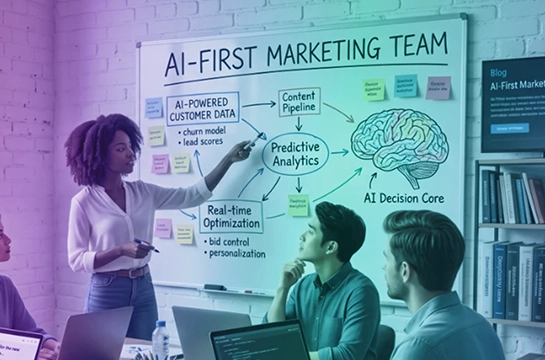
Agentic marketing describes a way of working where the marketer sets direction, constraints and judgement, and agents carry out multi-step execution against those constraints. Vibe marketing, in its workflow sense, describes the same thing. The difference is that agentic marketing has a definition that holds still, is used by analysts, and names what is actually happening: you are directing agents.
Vibe describes a posture instead. It borrows its authority from vibe coding, which meant something specific and slightly reckless: describe what you want, accept what comes back, do not read the diff. Karpathy's own limiting statement was that it was fine for throwaway weekend projects.
A strange foundation for a discipline, and the reason he replaced it. Vibe coding is describing what you want; agentic engineering is designing the system and specifying the constraints. The same distinction applies to marketing, and only one of the two words carries it.
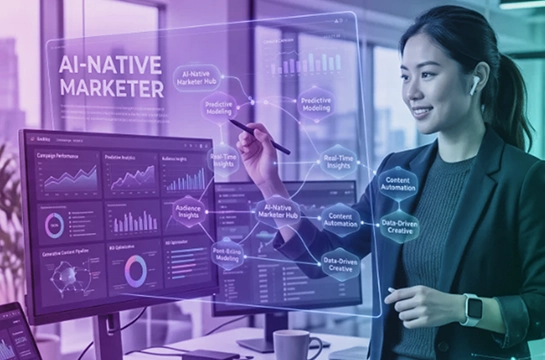
For the practice itself, we have written separately about AI marketing and what it means to work as an AI-native marketer.
The parallel is close enough to be useful, and nobody seems to have made it.
Sean Ellis coined growth hacking in a 2010 post looking for someone to do the job he had done at Dropbox. Andrew Chen amplified it in 2012 with an essay arguing the growth hacker was the new VP of marketing. Job titles followed, then conferences, then agencies, then a book.
Then the term attracted enough bad practice that Ellis himself acknowledged the fatigue, and practitioners drifted towards growth marketing, head of growth and product-led growth.
The discipline survived. The word did not, because it had come to mean cleverness rather than competence, and because the specific exploits it was built on stopped working.
Vibe marketing is following a recognisable version of that arc, accelerated. Coined in a founder's network, amplified by a mainstream masthead within days, attached to a handful of job titles, then fragmented into incompatible meanings while the people closest to it quietly moved to agentic language.
Our position: the practice is real, the word is not worth adopting.
If you are directing AI across research, production and testing, and keeping strategy and judgement for yourself, you are doing something genuine and increasingly standard. Call it agentic marketing, or AI marketing, or just marketing. Those words survive a definition check.
Do not put vibe marketing in a job specification, a strategy deck or a board paper. The person reading it has a one-in-four chance of picking the definition you did not mean, and a term that requires you to say which sense you intend is a term that has stopped doing its job.
We should concede what cuts against this. The term has more institutional traction than a pure fad would: MarTech ran a programmed Vibe Marketing Lab at its conference in March 2026, The Drum has covered it twice this year, eMarketer covered it in 2025. It is not dead.
It is just not precise, and precision is the whole point of a name.
One more practical note. The phrase is commercially crowded. There is a Web3 newsletter called Vibe Marketing OS, a paid community at thevibemarketer.com run by the people who coined the term, and a Chicago mobile marketing company called Vibes that has been trading since 1998.
If you search the term expecting a discipline, you will find businesses.
Vibe marketing usually means directing AI tools and agents to produce, test and run marketing that previously needed several specialists, with the human keeping strategy and judgement. A competing definition, used by Salesforce and much of the UK trade press, means building an emotional or cultural feeling around a brand and involves no AI at all. There is no agreed definition.
Greg Isenberg publicly named and defined it in a post on 22 March 2025, crediting James Dickerson with the underlying workflows. The phrase was circulating in their network from February 2025. It derives from vibe coding, which Andrej Karpathy coined on 2 February 2025.
In practice the workflow versions describe the same thing. Agentic marketing is the more precise term: it is used by analysts, it names what is happening, and its definition holds still. Hightouch publishes vibe marketing explainers while describing its own product as an Agentic Marketing Platform.
A small number of companies have advertised the title. The roles contradict each other: one Y Combinator company's Vibe Marketer posting is a part-time cultural and social role with no AI workflow in it, while the same job board carries AI-first marketing roles that match the workflow definition exactly under different titles.
No independently audited case study exists that isolates vibe marketing as an intervention and measures outcomes. Recorded demonstrations show one person can execute the workflow. Meanwhile survey data from April 2026 found 60.12% of marketing departments had grown headcount in the previous year against 8.9% that shrank it, which is hard to square with the one-marketer-replaces-ten claim.
We would not. If you mean the workflow, agentic marketing and AI marketing both describe it and both survive a definition check. A term that needs you to specify which of four meanings you intend has stopped working as a name.
For the broader category rather than the label, start with our guide to AI marketing. If you are thinking about the identity rather than the practice, read Explaining AI-Native Marketer. And if you want to build the capability without buying a platform, our B2B marketer's AI stack sets out what to run at £0, £40 and £150 a month.
SaaStrix is where B2B marketers become agentic marketing leaders, and you can try it free for five days.


.svg)