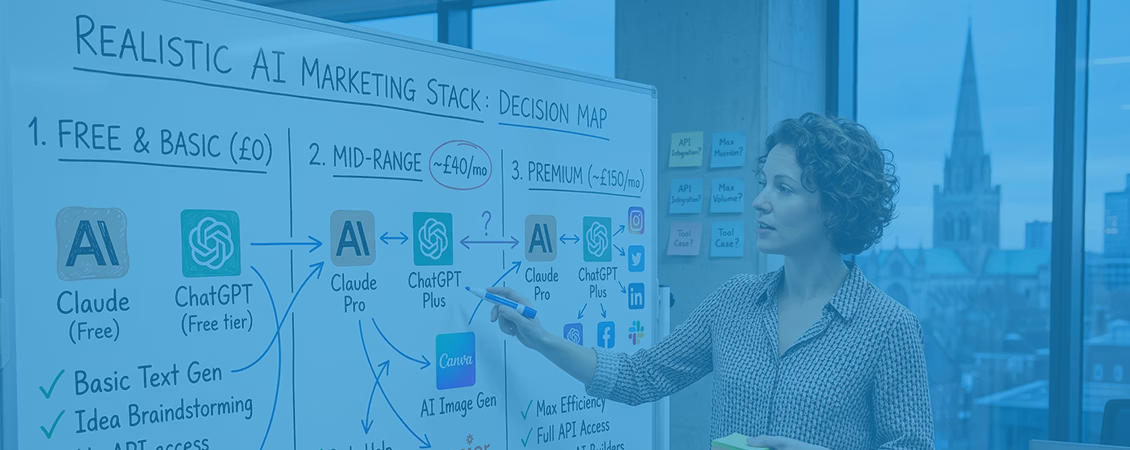
If you are the only person doing marketing and AI at your company, here is exactly what to buy, in what order, and what to ignore until you are bigger. You can build a genuinely useful AI marketing stack for nothing, sharpen it for around £40 a month, or run a near-complete setup for around £150. The free tier covers research, drafting and light automation; the £40 tier adds a paid frontier model, paid research and a proper automation tool; the £150 tier adds model choice, design at volume and room for agents.
A few notes before the tools. Prices below are billed in US dollars by most of these vendors, so the pound figures are approximate and move with the exchange rate; we verified them on 26 June 2026. UK VAT may be added at checkout, and VAT-registered businesses can usually reclaim it. We have led on price in pounds throughout because budget is the question this guide exists to answer. For the wider picture of what these tools are for, see our pillar, AI in Marketing: A B2B SaaS Marketer's Field Guide.
A working AI marketing stack only needs four jobs covered: a model to think and draft with, a research tool that cites its sources, an automation layer to connect things, and something to make visuals. Everything else is an upgrade, not a requirement.
That is the principle behind the three tiers. The £0 stack proves the workflow with free tiers of strong tools. The £40 stack removes the daily friction of free limits and adds proper automation. The £150 stack adds model choice, higher volume, and headroom for agents and specialist tools. Most small B2B teams should start at £0, move to £40 once the free limits start costing them time, and only reach for £150 when AI is doing enough work to justify it.
A free stack is more capable than most marketers expect, and it is the right place to start because it forces you to learn the workflow before you spend anything. Here is a complete one.
The honest limit of the free stack is the daily caps. The moment you find yourself rationing your own usage, or waiting for a limit to reset mid-task, the free tier is costing you more in time than the next tier costs in money.
The £40 tier buys away the friction. It pairs one paid model with paid research and a real automation tool, which together cover the daily work of a solo marketer comfortably.
That comes to around £40 to £43 a month for a setup that handles drafting, research and automation without you hitting a wall. For most small B2B teams, this is the tier worth living on for a good while. Our 90-day playbook is built around roughly this level of tooling.
The £150 tier is a near-complete setup for a marketer or small team running AI across most of their week. It adds model choice, design at volume, stronger automation, and room for agents and API use. A representative build:
That lands at around £150 a month, give or take, depending on which automation platform you choose and how much API headroom you use. Beyond this you are into enterprise tooling, which is a different guide.
Match the tier to how much of your week AI is doing, not to how much you want to look equipped.
The mistake is jumping to the top tier early. The tools are not the skill; the workflow is. A marketer on the £40 stack who has learned to delegate and review well will out-produce one on the £150 stack who has not.
The fastest way to overspend on AI is to buy a separate single-purpose tool for every task. Most "AI tool for X" products are a frontier model with a thin wrapper and a markup, and you already have the model. Before you subscribe to anything new, check whether the job can be done in the model you already pay for, or automated with the tool you already have.
A few specific things to be wary of. Standalone "AI writer" subscriptions rarely beat a paid frontier model you have learned to prompt well, and they fragment your work across tools. All-in-one "AI marketing suites" tend to be broad and shallow; you pay for twenty features and use three. And paying for the top usage tier of any model before you have hit the limits of the standard one is money spent on a problem you do not have yet. Buy the upgrade when the limit bites, not before.
The other quiet waste is tools you bought and stopped using. Review the stack every quarter, cancel what you have not opened in a month, and put that money into the one upgrade that is actually slowing you down. Knowing what to skip is part of being an AI-native marketer, and it is a more useful instinct than knowing every tool on the market.
What is the cheapest AI marketing stack that actually works?
A genuinely useful AI marketing stack can cost nothing to start. Free tiers of a frontier model (ChatGPT, Claude or Gemini), Perplexity for cited research, Google NotebookLM for your own documents, Canva for visuals, and Make or Zapier for light automation cover the core jobs. The limit is daily usage caps, which is the signal to move up a tier.
How much should a small B2B team spend on AI tools a month?
For most solo marketers and small teams, around £40 a month is the sweet spot: one paid frontier model, paid research, and a proper automation tool. Spend more only when AI is doing enough of your week that model choice, higher volume or agents clearly pay for themselves.
Do I need to pay for ChatGPT and Claude both?
Only at the higher end. One paid model covers most work. Running both (around £35 a month combined) buys model choice, since each is better at different tasks, which is worth it once AI is central to your week but not before.
Is a free AI marketing stack good enough for a startup?
Often, yes, at the start. A free stack proves the workflow and handles real work, as long as you can live with daily usage caps. Treat it as the place to learn before you spend, then upgrade the moment the limits cost you more time than the next tier costs in money.
Are standalone AI marketing tools worth it?
Usually not, if you already pay for a frontier model. Many are a model with a wrapper and a markup. Check whether the job can be done in the model or automation tool you already have before adding another subscription.
If you are choosing tools, start with the workflow they serve. Our pillar, AI in Marketing: A B2B SaaS Marketer's Field Guide, maps the use cases; the 90-day playbook sequences how to adopt them; and What Is an AI-Native Marketer? covers the skill that makes any stack pay off.
The stack is the easy part. The hard part is learning to use it well, on your real work, which is what we do inside SaaStrix through applied AI content and short courses for B2B marketers.
SaaStrix is where B2B marketers become agentic marketing leaders, and you can try it free for five days.


.svg)