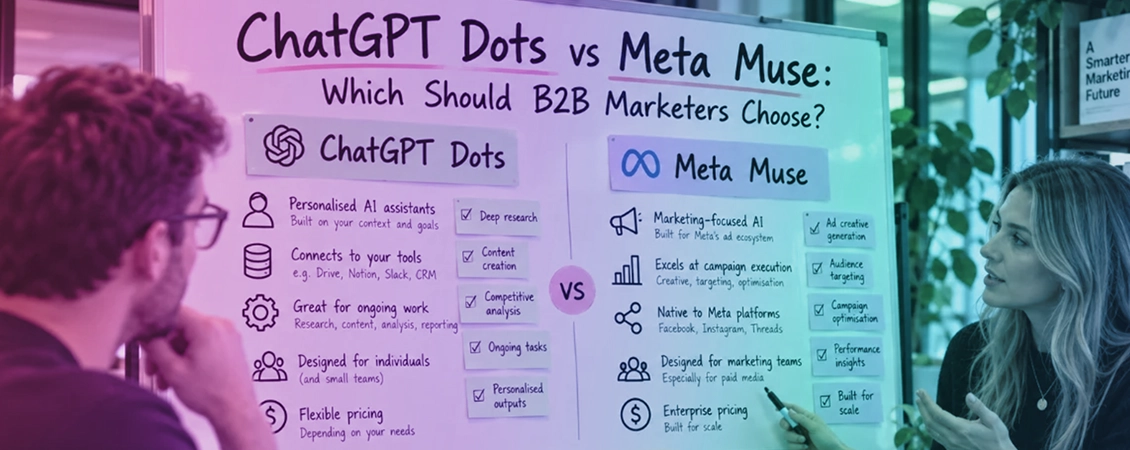
Our first month with a ChatGPT dot cost £138.65. There was no price at which we could have bought Meta Muse from the UK.
Choose ChatGPT Dots if your marketing runs on a CRM, Slack or Teams and you need a business contract behind the agent. It is also the only one of the two a UK or EU team can buy today. Choose Meta Muse if you work in the US or Canada, your marketing lives on Facebook and Instagram, and you want to start free.
Both are always-on AI agents with a cloud computer of their own, launched three weeks apart in September 2026. If you already have more AI tools open than you have a system for, a second agent launch in a month is one more tab. So this comparison skips the feature tour and follows the order the decision gets made in: access, cost, fit with your tools, then who governs the thing.
We run a dot on a UK business workspace, and we covered what a dot is and what to hand it in How to Use ChatGPT Dots for Marketing: 10 B2B Use Cases. We cannot test Muse from the UK. Everything here about Muse comes from Meta's own documentation and other people's published tests.
Last updated: 9 October 2026.
Where you work settles more of this choice than any feature does. Meta Muse is available in the US and Canada only, and Meta's 29 September announcement names no other country. ChatGPT Dots comes with the personal Pro plan everywhere except the UK, the EEA and Switzerland, and with a Business Premium seat in every region ChatGPT supports, according to OpenAI's help centre.
That leaves three situations:
Neither company has said when this changes or why the restriction exists. The regulatory explanations doing the rounds are guesses, and a VPN is a way round the terms, which is a different thing from access.
Muse is free to start and a dot is never free. Muse has a free plan with a usage limit that refreshes, and two paid plans at $20 and $100 a month. Neither vendor publishes a sterling price, so the dollar figures here are list prices.
You cannot buy a dot separately. Your first comes with Pro, at $100, $200 or $500 a month, or with a Business Premium seat at $125 a month, or $100 a month billed annually. A Business workspace needs two seats and one of them can be a $25 Standard seat, which is how our bill came to $150 before tax.
What nobody can tell you yet is the running cost. OpenAI says the allowance for deeper work has extended limits for the first month after launch, and it has not published what follows. Meta counts usage in its own Muse tokens and does not say how much work a token buys.
Budget for the subscription. Treat any figure for a typical marketing workload as a guess until someone has measured one.
Dots suit a marketing team that already works in a CRM and a chat tool, and needs the agent to sit under a company contract.
It has a documented route into your CRM. HubSpot's documentation says its ChatGPT connector can create and update contacts, deals and campaigns, capped at ten records per request, once a Super Admin approves it. Neither HubSpot nor Salesforce is among the connectors Meta named for Muse. One caveat matters here: OpenAI does not publish which apps a dot can use, and says only that availability depends on the app, your plan, your region and your workspace.
It works where your team already talks. You can message a dot in ChatGPT, Slack and Microsoft Teams, and it carries context between them. Only its owner can direct it, so a colleague's mention in a channel starts nothing.
It comes with business terms. OpenAI does not train on Business, Enterprise or Edu workspace content by default. Enterprise admins can switch dots on by role, and separately control browser use, network access and access to a member's own computer.
Muse suits a marketer in North America whose audience and ad spend sit on Meta's platforms. It also suits anyone there who wants to try an always-on agent without raising a purchase order.
It costs nothing to try. One published ten-task test of Muse was run entirely on the free plan.
It is native to Meta's own platforms. Muse for Small Business, launched on 29 September, connects Instagram professional analytics, Facebook Pages and Meta ad accounts. The same release added Asana, Canva, Figma, Klaviyo, Notion, Shopify, Slack, Stripe and Zoom. Dots reach Meta Ads only through third-party plugins.
Its approval promise is blunt. Meta's wording for the business release is that nothing publishes, sends or spends without your approval. You grant read and write access app by app, and a separate system called Sentinel controls what the agent can reach.
You can read what it remembers. Meta's help pages describe a memory file you can open and edit. A dot's individual memories cannot be viewed or deleted, and the only way to clear them is to delete the dot.
Neither has been shown to do a B2B marketing job from start to finish. We found vendor examples and short individual tests, and no measured deployment at a B2B SaaS company for either product.
A browser is a poor stand-in for a missing connector. Both agents can drive a browser when no connector exists, and both then meet logins, bot checks and changed page layouts. A dot's cloud computer does not inherit your VPN or your browser sign-ins. LinkedIn is harder still, because its user agreement bars unauthorised automated access, and we found no documented route for either agent to publish there.
You cannot leave with your work. Neither vendor documents an export of an agent's instructions, schedules, permissions and history as one package. Self-service data export is not available in ChatGPT Business or Enterprise workspaces at all. Keep the master copy of every brief somewhere you own.
Both make mistakes. OpenAI's launch post says dots can still make mistakes and tells you to review consequential work. Treat what either agent produces as a draft.
For fixed, high-volume steps with known inputs, an automation tool is still the better buy. We compared three in Zapier vs Make vs n8n: Which Is Right for B2B Marketers?.
One publisher has tested both, and the result is weaker evidence than it looks. AI Agents Library ran ten business tasks on a dot and scored it 8.8 out of 10. It scored Muse 8.0 across the eight tasks it could grade.
The author calls the comparison directional. The two runs used different dates, accounts and task set-ups, and the publisher sells AI training. Four of the ten Muse tasks produced no score, two of them because the tester declined to hand over a password or full access to a Mac.
The detail is more useful than the totals. Muse scored 10 out of 10 on meeting preparation and 6 out of 10 on inbox triage, after an error the tester said would have caused a real mistake. We'd treat 8.8 against 8.0 as the least useful number in this comparison, because no controlled test has put the same marketing tasks through both.
Dots have an organisation layer and Muse has none. For a team handling customer data, that is the biggest difference between them.
Muse's controls belong to the individual user. We found no team plan, admin console or published data processing agreement for it, and its training setting is on until you turn it off.
Meta says Muse conversations and the data in its virtual machine are not shared with its advertising systems. WIRED reported that Meta accepts the machine is not technically closed to Meta itself, and a confidential version is promised for later this year.
Muse also has the longer incident record, after three more weeks in public. Amazon began blocking it on 20 September. Meta patched a flaw in the Mac app on 22 September, a day after the researcher Patrick Wardle disclosed it.
No comparable incident has been reported for dots, which proves little about a product ten days old. The dots controls are also thinner than they first appear. OpenAI documents the admin settings for Enterprise, where dots are off by default, and says nothing equivalent about Business.
In the Enterprise beta, dots do not support data residency. If customer data is involved, write the limits down before you connect anything. Our AI Governance for B2B Marketing Teams: The One-Page Policy is a place to start.
You work in the UK or EU. The decision is a dot on a Business Premium seat, or waiting. Buy on monthly billing so you can leave when OpenAI publishes its usage terms. Wait if you cannot name one recurring job worth $150 a month.
You are a solo marketer in the US or Canada. Start with Muse's free plan. If you already pay for ChatGPT Pro, your first dot is included, so run both on the same job for a fortnight.
You run a small B2B SaaS team on HubSpot or Salesforce. Dots. It is the only one of the two with a documented CRM route and a business contract. Begin with read access and switch on writes one action at a time.
Your marketing and ad spend sit on Facebook and Instagram. Muse, if you are in North America. Nothing else connects to Meta's ad accounts natively.
You are an agency holding client data. Neither on a personal login. If a client approves it, use a dot on a business plan with that client's data kept separate.
Whichever you pick, give it one or two read-only jobs for 30 days, such as a weekly competitor watch with every source linked. Do the job by hand first so you have a baseline. Then count how often the output was usable without repair and how long the checking took, and stop if the checking takes longer than the job did.
What is the difference between ChatGPT Dots and Meta Muse?
Both are always-on AI agents with their own cloud computer and browser. ChatGPT Dots is included with paid ChatGPT Pro and Business Premium plans and is built around work tools such as CRMs, Slack and Microsoft Teams. Meta Muse has a free plan, is available in the US and Canada only, and connects natively to Facebook, Instagram and Meta ad accounts.
Is Meta Muse available in the UK?
No. As of 9 October 2026, Meta Muse is available in the US and Canada only, and Meta has not named any further country or a date. There is no supported way to use Muse from the UK or the EU.
Can I use ChatGPT Dots in the UK or EU?
Yes, on a business plan. Dots are excluded from the personal ChatGPT Pro plan in the UK, the EEA and Switzerland, and included with a ChatGPT Business Premium seat, and with Enterprise workspaces once an admin switches them on. A Business workspace needs at least two seats, and only one of them has to be Premium.
Is Meta Muse free?
Yes. Meta Muse has a free plan with a usage limit that refreshes, and two paid plans at $20 and $100 a month with larger weekly allowances. ChatGPT Dots has no free plan: your first dot is included with ChatGPT Pro, from $100 a month, or with a Business Premium seat at $125 a month.
Which is better for B2B marketing, ChatGPT Dots or Meta Muse?
For a B2B team that runs on HubSpot or Salesforce, Slack or Teams, ChatGPT Dots is the better fit, and it is the only one of the two available in the UK and EU. Meta Muse is the better fit for a marketer in the US or Canada whose marketing lives on Facebook and Instagram. No controlled test has compared them on the same marketing tasks.
Can ChatGPT Dots or Meta Muse post to LinkedIn?
We found no documented route for either agent to publish to LinkedIn. Both can operate a browser, and LinkedIn's user agreement bars unauthorised automated access, so posting that way puts your own account at risk. Have the agent draft the post and publish it yourself.
SaaStrix is where B2B marketers become agentic marketing leaders, and you can try it free for five days.



.svg)