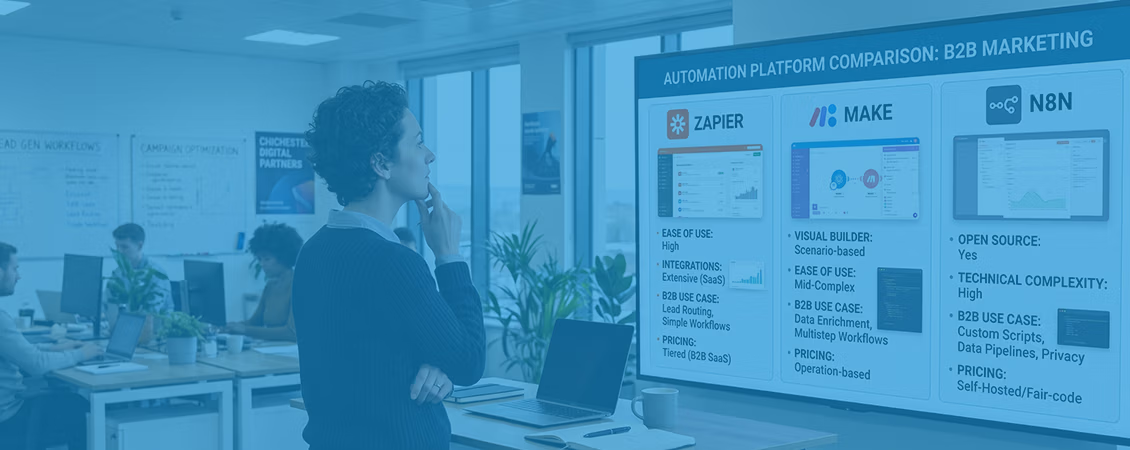
The same lead-routing workflow can cost 5,000 "runs" on one of these tools and 40,000 "tasks" on another. Same work. Eight times the bill.
For most B2B marketing teams, the honest answer is this: start on Zapier if you need automations live this week and nobody on the team codes, move to Make when workflows get complex and the bill starts to sting, and reach for n8n when you have technical help and want AI agents running on your own infrastructure. The right tool depends far less on features than on three things: how your team works, how much you run, and what you want AI to actually own.
Zapier, Make and n8n all do the same core job. They connect the apps in your marketing stack so work happens without anyone copying and pasting between tabs. All three now also do something bigger, covered below. But marketers agonise over the choice because the pricing looks similar on the surface and behaves completely differently the moment you scale. Get the model wrong and one successful campaign can quietly mug your automation budget. This is not a feature checklist. It is a guide to picking the one that fits how you actually work.
If you want the wider picture of where these tools sit in an AI marketing stack, we have covered that in AI in Marketing: A B2B SaaS Marketer's Field Guide. This piece is about choosing between the three.
Think of them as the glue between your apps. A lead fills in a form, that creates a contact in your CRM, which triggers an AI model to draft a personalised follow-up that lands in the rep's inbox with a Slack nudge. Nobody touched a keyboard. That chain is the whole point, and all three build it from the same two parts: a trigger (something happens) and one or more actions (the results).
Where they differ is who they are built for.
Zapier is the one most marketers meet first. It connects around 8,000 apps, the widest coverage of the three, and you can wire two of them together in an afternoon with no technical background. A single workflow is called a "Zap."
Make (formerly Integromat) gives you a visual canvas where a workflow looks like a flowchart, with the data paths drawn out in front of you. It handles complicated, branching logic far more gracefully than Zapier, in exchange for a slightly steeper climb at the start. It connects to roughly 3,000 apps.
n8n (say "n-eight-n") is the open-source option. You can run it on your own server for nothing but the hosting, get unlimited workflow runs, and drop into a bit of code inside any step to reach almost any system you like. It is the most powerful and the most technical of the three.
Here is the part most comparisons skip, and the part that actually decides your bill. The three tools count usage in three different ways, and that difference is worth more than any feature.
Zapier counts tasks. Every single action step is one task. A workflow that watches a form, enriches the lead, scores it, updates the CRM and pings Slack burns about five tasks every time it runs. AI-heavy steps burn more.
Make counts operations (rebranded as "credits" in August 2025, though the maths is the same for standard steps). It is similar to tasks, but loops multiply fast: processing ten line items can count as ten operations, and AI steps cost a multiple of a standard one.
n8n counts executions. One complete workflow run is a single execution, no matter how many steps sit inside it. That same five-step lead workflow is one execution on n8n versus five tasks on Zapier.
Now put real volume through it. A lead-qualification workflow that enriches, scores and routes might be five to eight steps. At 5,000 leads a month, that is 25,000 to 40,000 tasks on Zapier against 5,000 executions on n8n for identical work. That is why two tools with near-identical headline prices can produce wildly different invoices.
The headline numbers, billed annually (monthly is roughly a third more):
Independent testers consistently land Make at roughly three to five times cheaper than Zapier for the same branching work, with self-hosted n8n cheaper still. The practical move before any annual plan: build one real workflow from your own stack, run it on the free tier for a week, and measure what it consumes. Your own numbers beat any average.
Speed and breadth. Nothing else gets a non-technical marketer to a working automation faster, and nothing else connects to as many tools. If your stack includes some obscure piece of software, Zapier probably already supports it, and those connections update themselves when the app changes, so you are not the one fixing them. For a small team that wants lead alerts, calendar-to-CRM syncs and webinar follow-ups live this week, it is the obvious starting point. The catch is the one above: it is the most expensive to scale, and its pricing punishes the exact behaviour you want to encourage, which is automating more.
Power for the money. Make is the visual middle ground: far more capable than Zapier on complex, branching workflows, far cheaper at volume, and approachable enough that a curious marketer can learn it without being a developer. The flowchart canvas also makes it easy to see what a workflow is doing, which matters once an automation is touching your CRM or emailing prospects. The trade-off is the learning curve: data mapping and error handling take a week or two to click, and the per-user team pricing can sting a growing agency.
Depth, control and cost at scale. n8n is the most genuinely AI-native of the three. It can run AI agents with memory and reasoning, connect them to your own knowledge base so they work from your data rather than the model's training, and even run AI models locally for full privacy. Self-hosting means your automation infrastructure is yours, which matters for data-sensitive UK and European teams, and per-execution billing saves real money once volume climbs. The price of all that is technical commitment: someone near the team needs to be comfortable with APIs, and self-hosting is a system you maintain, not a tool you dabble in.
For a decade these tools did one thing: if this happens, do that. That still covers most of what you will automate. But all three have repositioned around something that matters more if your team is going AI-native. Instead of scripting every step, you hand an AI agent a goal and the tools to reach it, and it works out the steps. Zapier has Agents and a plain-English builder called Copilot. Make has AI agents built into its visual canvas, plus a conversational builder called Maia. n8n goes deepest, with agent building aimed at technical teams.
That reframe changes the question. You are no longer only asking "which tool connects my apps." You are asking "which platform lets an agent own an outcome," whether that is qualifying every inbound lead or turning one pillar article into a fortnight of social posts (we have broken down ten of these builds in AI in Marketing Examples: 10 Real B2B SaaS Workflows). HubSpot's 2026 State of Marketing report found most marketers now see AI as the biggest disruption to the profession in twenty years, and the move from single prompts to agents doing real work is the heart of it.
A word of realism for your leadership team: treat agents as capable junior colleagues, not set-and-forget replacements. They are reliable for structured jobs like classifying, summarising and routing, and still shaky on fully autonomous decisions. Keep a human approving anything that touches a customer or your brand.
The honest bit. None of these tools will design your process for you. They automate the workflow you give them, so a messy, undocumented process just becomes a messy automated one that is harder to untangle. All three can also fail quietly: a renamed field or an updated app, and your "set and forget" workflow stops mid-campaign without telling you. Whichever you pick, someone owns the job of watching it. The tool is the easy part. The thinking is still yours.
If you are a small or non-technical team that needs wins this week: Zapier. The premium is real, but so is the speed, and at low volume the bill is trivial. Start here, and do not feel you have to leave.
If you have a marketing-ops mindset and your workflows are getting complex: Make. It is the best balance of power, transparency and price for teams that have outgrown simple automation but do not want to write code. This is the right home for most B2B marketing teams running real campaign and lead workflows.
If you have technical help and serious AI ambitions: n8n. Custom agents, your own data, high volume, and information you would rather keep on your own servers: this is where the per-execution model and the open-source ceiling pay off.
And if you cannot decide, you do not have to marry one. Plenty of mature teams run Make or n8n as the engine for the heavy, high-volume work, keep Zapier for quick one-off automations and its unmatched app list, and let a dedicated AI model do the actual writing. The skill is not picking the perfect tool. It is matching the model to the outcome you want, the volume you will run, and the people you have got.
The fastest way to learn which one fits is to build something real. Inside the SaaStrix community, our AI Labs walks through these workflows step by step, with the prompts, screenshots and copy-paste templates, plus a room full of B2B marketers comparing notes on what is working. This guide answered the what and the why. That is where you get the how.
Which is best for B2B marketers: Zapier, Make or n8n?
Start on Zapier if you need automations live this week and nobody on the team codes, move to Make when workflows get complex and the bill starts to sting, and reach for n8n when you have technical help and want AI agents running on your own infrastructure. The right tool depends less on features than on how your team works, how much you run, and what you want AI to own.
What is the real pricing difference between Zapier, Make and n8n?
The billing model matters more than the headline price. Zapier counts every action step as a task, Make counts operations, and n8n counts one execution per complete workflow run. At 5,000 leads a month, a five-to-eight-step workflow is 25,000 to 40,000 tasks on Zapier against 5,000 executions on n8n for identical work.
Which of the three is cheapest?
Independent testers consistently land Make at roughly three to five times cheaper than Zapier for the same branching work, with self-hosted n8n cheaper still, since the software is free and you pay only for a small server. Before any annual plan, build one real workflow from your own stack, run it on the free tier for a week, and measure what it consumes.
Can Zapier, Make and n8n run AI agents?
Yes, all three now can. Zapier has Agents and a plain-English builder called Copilot, Make has AI agents on its visual canvas plus a conversational builder called Maia, and n8n goes deepest with agent building for technical teams. Treat agents as capable junior colleagues, with a human approving anything that touches a customer or your brand.
Do you have to pick just one automation tool?
No. Plenty of mature teams run Make or n8n as the engine for heavy, high-volume work, keep Zapier for quick one-off automations and its unmatched app list, and let a dedicated AI model do the actual writing. The skill is matching the model to the outcome, the volume and the people you have.
SaaStrix is where B2B marketers become agentic marketing leaders, and you can try it free for five days.




.svg)