Most advice says to feed the model samples of your writing. The largest study of that approach found it falls well short on the writing most marketers actually produce. What to put in the document instead, and the three sections that do the work.
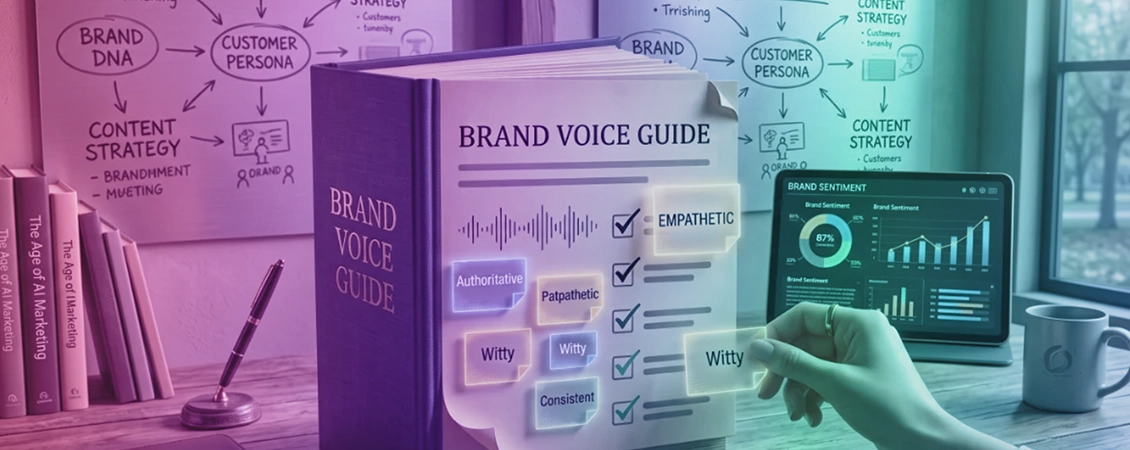
A brand voice guide for AI should be written as constraints a model can be checked against, rather than as a description of how your brand sounds. Three sections carry it: banned patterns with replacements, a claim rule, and judgement calls shown with a wrong version. The model will not sound like you. It can be stopped from sounding like itself.
That is a smaller promise than this category usually makes. It is also the one the evidence supports.
Because it was written for people who can infer, and a model cannot.
Look at the two halves of the Mailchimp content style guide, probably the most copied voice document in marketing. One half is traits: the voice is genuine, the humour is dry, the brand prefers winking to shouting. The other half is rules: use active voice, use short words and sentences, cut unnecessary modifiers, use the serial comma, never combine italic, bold, caps and underline.
A person reads the traits half and converts it into a hundred small decisions. A model has nothing to convert it with. Paste 'we prefer winking to shouting' into a prompt and there is no test the output can pass or fail.
Paste 'use the serial comma' and there is.
The Nielsen Norman Group's four tone dimensions, published in 2016 and still the standard reference, has the same shape. It was built to diagnose copy that already exists, with human raters. It gives you a coordinate.
Coordinates do not tell a model what to do with a sentence.
Less than the advice assumes. This is the finding that should change how you write the document.
Zhengxiang Wang and colleagues published the largest test of the idea at EMNLP in November 2025: over 40,000 generations per model across six models, using real writing from more than 400 authors, measured by whether the output could be attributed back to the author it was imitating. Models approximated style reasonably in structured formats like news and email. They struggled with informal, stylistically varied writing such as blogs and forums, which is closer to how most marketing copy reads.
The paper's own summary names a fundamental gap in personalised adaptation.
They also varied the number of examples. More samples did not keep improving things.
So samples earn their place. They beat giving the model nothing. What they will not do is get you to your voice, which means a guide built on 'here are ten things we've written, sound like this' rests on the weakest mechanism available.
Keep the samples if you have already loaded them into a Claude Project or a custom GPT, a setup we covered in Claude for Marketing: How B2B SaaS Teams Actually Use It. The document beside them is where the work happens.
Stop treating it as a style-transfer device and start treating it as a constraint list with a test attached.
One question governs every line you write: could someone hold the output next to it and say yes or no? 'Be conversational but authoritative' fails that test. 'No sentence longer than 30 words' passes it.
A guide made only of lines that pass is shorter than the one you have, and it is the only part of the document that changes what comes back.
Three sections cover it. We call them bans, proofs and calls, which is unglamorous and easy to remember. Bans are the patterns that must not appear.
Proofs are the rule that governs claims. Calls are the judgement decisions, written out with the wrong answer visible.
The words, phrases and structures you refuse, each one paired with what to write instead.
The pairing is the part people skip. Models handle flat prohibitions poorly: Jang, Ye and Seo tested negated prompts in 2022 and found larger models often did worse than smaller ones, behaving as though the negation were not there. Those were earlier models and nobody has published a failure rate for current ones, so treat it as a working assumption, not a measured fact.
Both OpenAI and Anthropic tell users in their own prompting documentation to say what you want rather than what you don't. So 'never write supercharge' becomes 'where you want to write supercharge, state what changed and by how much'.
The underlying tics are real and measurable. Dmitry Kobak and colleagues, publishing in Science Advances in July 2025, studied vocabulary across more than 15 million PubMed abstracts from 2010 to 2024 and found an abrupt jump in a specific set of style words once language models arrived. Their estimate is that at least 13.5% of 2024 abstracts were processed with a model, reaching 40% in some subcorpora, an effect on scientific vocabulary larger than Covid's.
That is what a bans list targets. Recurring, countable failures.
One rule about evidence, written so that any sentence either satisfies it or does not.
Ours is three words: receipts before claims. Every claim that leans on outside evidence carries a publisher name and a date in the prose, or it gets cut. No 'studies show'.
No statistic whose only source is another blog post quoting it.
This does more work than it looks like it does. A model asked to write persuasively reaches for numbers, and the numbers it reaches for are often real-sounding, widely repeated and untraceable. We have turned down viral statistics for exactly this reason, including a very well-travelled figure about AI project failure rates that we could not trace to a primary source.
Refusing it cost us a punchy line and bought us a page a reader can check.
A claim rule is checkable in a way that 'be credible' never is. That is the whole test.
The judgement decisions, each written as a pair: the right version and the wrong version, side by side.
Here is the gap in almost every published voice guide. Neither the Nielsen Norman framework nor the Mailchimp guide contains a single negative worked example. Not one 'and here is the version that misses, and why'.
The wrong version is where most of the information lives, because it draws the line in a place a reader, or a model, can actually see.
So instead of 'we are direct but warm', write two sentences about the same thing, mark one wrong, and say in six words what makes it wrong. Do that for the decisions your team argues about most: how you open, how you handle a claim you cannot fully evidence, when you name a competitor, how much hedging is honest rather than cowardly.
Ten pairs will do more than a page of adjectives.
Short, and mostly a list of things not to do.
The bans include unlock, supercharge, game-changing, world-class and masterclass, each paired with a replacement instruction. There is a terminology rule that the word 'train' never leads a sentence about what we do, because it drags in a classroom association we do not want. The proofs section is the receipts rule above.
The calls section is worked pairs.
What it does not contain is a description of our voice. No adjectives, no tone coordinates, no paragraph about who we would be if we were a person. We took those out because we could not find a way to check them, and a line nobody can check is a line the model can ignore without anyone noticing.
Publishing it is a small risk. It means anyone can see the list and spot us breaking it. That seems like the right trade.
No, and this is the decay most teams never notice.
Meta's Multi-IF benchmark, published in late 2024, ran 4,501 three-turn conversations across 14 models and found every model followed instructions worse with each additional turn: o1-preview fell from 0.877 average accuracy at turn one to 0.707 by turn three. Laban and colleagues at Microsoft Research and Salesforce Research went further in May 2025, simulating over 200,000 conversations across 15 models and reporting an average 39% performance drop between single-turn and multi-turn, driven mostly by unreliability rather than by any loss of ability.
The practical version: paste the one-page guide back in when a chat gets long. It is not still running just because you loaded it at the start.
Two things, both outside your control.
The first is model versions. Chen, Zaharia and Zou documented substantial behaviour change between two releases of the same named service in their Harvard Data Science Review paper, and every provider now ships style changes with upgrades. Keep half a dozen representative briefs with outputs you were happy with, and re-run them when the model underneath you changes.
The second is that the bans date. The word lists that identify model writing are tied to the period and the corpus they were built from. Rebuild yours each quarter from your own recent drafts.
Somebody else's list of AI words is already behind.
Nobody has proved it, including us. You should know that before you spend an afternoon on it.
No published study compares a description-based voice guide against a rules-and-examples one on the same brand, same model, same task. It is the obvious experiment and nobody has run it. The commercial tools are worse.
Across Jasper, HubSpot, Writer, Grammarly and Semji we found no controlled study, no benchmark and no independent evaluation of whether their brand voice features improve anything at all. The closest thing to a number is Grammarly's claim that beta teams using its brand tones came out 40% more on-brand, published without the method behind it.
So treat this as working practice, not settled method. The argument for checkable rules is modest and it holds: you can tell whether they were followed. Everything else on offer here is an assertion, and ours is at least one you can audit.
If you want the fuller setup this sits inside, our 90-day playbook for using AI in B2B SaaS marketing covers the week-one foundations.
A short document that tells an AI model how your brand writes, written as constraints the output can be checked against rather than as a description of your tone. The useful version has three sections: banned patterns each paired with a replacement, one rule governing claims, and judgement calls written out with a wrong version alongside the right one.
One page is usually enough. Every line should be something you can hold an output next to and mark pass or fail, and most adjective-based descriptions of voice fail that test, so they come out. A short guide you actually re-paste into long conversations beats a long one nobody loads.
A small, varied set covering the formats you need. Research published at EMNLP in November 2025 tested style imitation across six models and more than 400 authors and found that adding more examples did little for stylistic alignment, so there is no evidence for a magic number. Samples help, and they will not reproduce your voice.
Both, but never a bare prohibition. Pair every banned word or pattern with what to write instead, because models handle negation poorly and both OpenAI and Anthropic tell users in their own prompting documentation to say what you want rather than what you do not.
No. Jasper, HubSpot, Writer, Grammarly and Semji all take some mix of writing samples and explicit rules, so you still have to decide what those rules are. None of them publishes a controlled study or an independent evaluation showing that its brand voice feature improves output.
Re-paste it inside long conversations, because instruction-following degrades turn by turn. Re-test it whenever the underlying model changes, using a fixed set of briefs and outputs you were happy with. Rebuild the banned list each quarter from your own recent drafts, since the words that mark model writing shift over time.
SaaStrix is where B2B marketers become agentic marketing leaders, and you can try it free for five days.





.svg)