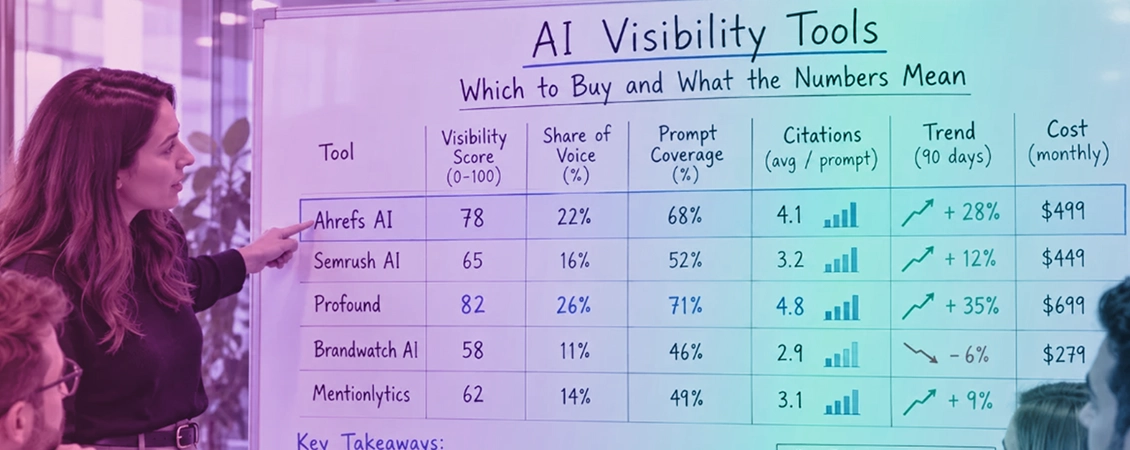
Two AI visibility tools will give you two different share-of-voice numbers for the same brand, and neither is wrong. AI visibility tools measure how often ChatGPT, Perplexity, Gemini and Google's AI features mention or cite your brand when a set of buyer prompts is sampled. The score depends on which prompts, which engines, how often, and how the vendor weights the result.
For a B2B SaaS team the right buy is a tool that fits one measurement job, paired with a fixed prompt panel you own and first-party data you already have. That is a different purchase from rank tracking with a new logo, and it is why most tool comparisons in this category miss the point. They rank features, when the thing that decides whether the number on your dashboard means anything is the measurement design behind it, and no vendor sells that.
This guide covers what the tools measure, why they disagree, which ones fit a £0 to £10m ARR SaaS team, and how to turn a reading into a decision. If you want the on-page tactics that earn citations once you know where you stand, we have covered those separately in How to Get Cited by ChatGPT: A B2B Marketer's Playbook. This piece owns the dashboard.
An AI visibility tool runs prompts against AI assistants on a schedule, stores the answers, and counts four things: how often your brand is named, how often your pages are linked as sources, where you sit among the brands mentioned, and what tone the answer takes. Everything else in the category is a view on those four counts.
The vocabulary is not standardised, which matters more than it sounds. A brand mention means your name appeared in the prose. A citation means a page was linked as a source, and it may be your page or a third-party page about you.
Those two come apart more often than you would expect. Semrush and Kevin Indig examined 3,981 domain appearances across 115 prompts and four AI systems in June 2026 and found 62% were what they called ghost citations: the source was linked but the brand was never named. Position is where you appear in a list of brands, sentiment is a model's classification of tone, and prompt coverage is the share of tracked prompts in which you show up at all.
Each vendor then rolls those primitives into a headline score. Semrush combines topic coverage with mention consistency into a 0 to 100 figure and says plainly in its own methodology notes that the metrics are directional. Ahrefs models estimated impressions by weighting mentions with the Google search demand behind each prompt and describes them as potential rather than actual reach, while Profound and Peec report visibility as the percentage of tracked answers that name you.
Because they are not measuring the same thing. Ahrefs Brand Radar computes share of voice as your share of modelled impressions against competitors, with high-demand prompts carrying more weight. Peec computes it as your share of mentions across the answers it collected, so a brand can score well on visibility and poorly on share of voice if a competitor is named even more often in the same answers.
Put those two figures side by side and you are comparing a demand-weighted estimate with a raw frequency. Three other things push the scores apart. The prompt universe is different: Ahrefs runs hundreds of millions of search-derived questions through the assistants, Semrush generates a synthetic prompt set from your domain, and Peec, Otterly and Profound run the prompts you give them.
The engine list is different, and full coverage is usually gated behind the top tier. And the collection method is different: Peec and Otterly both state that they interact with the public consumer interfaces rather than calling model APIs, because API answers and consumer-app answers diverge. Google's own documentation says AI Overviews and AI Mode can use different models and return different links, so measuring the Gemini app is not measuring Google AI Mode either.
The practical rule follows directly. Pick one tool for your time series and keep it. Use a second tool only as a qualitative cross-check, never to reconcile numbers.
Not stable enough for a single check to count as a measurement. Ronald Sielinski's March 2026 preprint on quantifying uncertainty in AI visibility ran 200 queries in each of three categories across Perplexity, SearchGPT and Gemini, daily for nine days and at ten-minute intervals in a high-frequency test. Citation rankings moved enough between runs that the confidence intervals for competing domains routinely overlapped.
A second preprint from Schulte, Bleeker and Kaufmann in April 2026 reached the same conclusion across ChatGPT, Gemini, Google AI Mode and Perplexity over roughly six weeks: measure repeatedly or do not trust the reading. Vendor data agrees. Writesonic reran prompts at least ten times each across seven platforms between March and June 2026, nearly 632,000 prompt-model pairs in total, and found the number-one brand changed in 52% of ChatGPT query runs.
So a dashboard line that says visibility is 31.7% is offering false precision. A line that says the 28-day mention rate across 30 prompts and three engines moved from 27% to 32% is offering a measurement.
The discipline is simple. Freeze the prompt wording, collect on a schedule, report rolling 28-day movement rather than daily wobble, show engines separately before rolling them up, and keep the raw answers so a change can be explained. One screenshot is an anecdote.
More than you did in May, and it is free. Google Search Console added a generative AI performance report on 3 June 2026 and rolled it out to all sites worldwide on 31 August. It shows how often your URLs appear in AI Overviews and AI Mode, broken down by page, country, device and date.
It shows impressions only: no clicks, no click-through rate, no queries, though Google says more metrics may follow. For now it is the only first-party view of Google AI visibility you will get, and it counts impressions of your pages rather than mentions of your brand.
Google Analytics 4 added a native AI Assistant channel on 13 May 2026. Google's channel documentation names ChatGPT, Gemini, DeepSeek, Copilot and Grok as recognised sources and states that AI Overviews and AI Mode are excluded, because clicks from Google's own AI features still arrive as Google organic. Perplexity is not on Google's published list as we write, so it lands in Referral unless you keep a custom channel group with a source regex alongside the native one.
A meaningful share of assistant clicks arrive with no referrer at all and sit in Direct, which is why every AI referral figure is a floor rather than a total. Bing Webmaster Tools has an AI Performance report covering Copilot citations. It is small, but it is the only assistant-side citation count you get for nothing.
Rank by job, not by feature count. The five below cover the sensible range for a £0 to £10m ARR team, listed in no particular order. Prices are vendor list prices checked on 12 September 2026, converted at roughly £0.75 to the dollar and rounded; confirm before you buy, because every vendor here has changed pricing at least once this year.
Semrush AI Visibility Toolkit, £74 a month ($99, billed annually, per domain). 25 tracked prompts checked daily, plus a large discovery database, across ChatGPT, Google AI features, Gemini and Perplexity. The right first step if you already pay for Semrush and want AI visibility beside your SEO data. What it is bad at: 25 prompts is tight for a real panel, extra prompt packs are $60 per 50, and the auto-generated prompt set needs replacing with your own buyer language before you trust the trend.
Peec AI, £71 a month ($95 for 50 prompts across three engines, daily). The cleanest specialist tracker at the entry tier: visibility, position, sentiment and cited sources per prompt, unlimited seats, and an unusually transparent statement that it scrapes the consumer interfaces rather than the APIs. What it is bad at: three engines is the ceiling on every self-serve plan, and additional models are paid add-ons.
Otterly.AI, £22 a month ($29 for 15 prompts) or £142 ($189 for 100). The cheapest way to find out whether a paid tracker will change your decisions. Four base engines on every plan (ChatGPT, Google AI Overviews, Perplexity, Copilot), daily runs, full answer capture and cited URLs. What it is bad at: the jump from 15 to 100 prompts is a sixfold price jump, Gemini and AI Mode cost extra, and Claude is not covered.
Ahrefs Brand Radar, from £149 a month ($199 per AI platform index, $699 for all, on top of an Ahrefs plan from $129). A different tool for a different question. Its index of search-backed prompts lets you look up any brand's mentions, citations and cited domains without configuring a panel, which makes it the best discovery layer in the category, and custom prompt tracking is a separate package from $50 a month. What it is bad at: the all-in cost for full coverage sits around $828 a month, index refreshes are monthly rather than daily, and it does not replace a fixed buyer panel.
Profound, £74 a month ($99 Starter) or £299 ($399 Growth). The deepest response-level data in the category and the most credible enterprise product, but the Starter tier tracks ChatGPT only, so the real entry point for multi-engine work is Growth at 100 prompts across three engines. What it is bad at: broad engine coverage and API access are enterprise-only, and the seat count is one on Starter and three on Growth.
The manual panel, £0 in software. Twenty to thirty prompts, run by hand across two or three engines every week, logged in a spreadsheet with the answer, the brands named, the cited URLs and the date. It is the right place to start, and it is what proves whether any of the tools above would change a decision. The cost is repetition, which is exactly what the volatility research says you cannot skip.
Start from the questions your buyers ask assistants, not from a vendor's suggestion list. A working panel for a B2B SaaS brand needs 20 to 30 prompts across five jobs: direct category recommendations (best tools for X), problem prompts (how do I fix Y), comparisons (A vs B), alternatives (something like A but cheaper), and high-intent use cases (tool for X that integrates with Z). Pull the wording from sales call transcripts, support tickets, your own site search and the search terms your paid campaigns already buy.
Then freeze it. The panel is a measurement instrument, and every time someone edits a prompt because it would be nice to know, the trend breaks. Tag each prompt by funnel stage and by whether it names a competitor, so you can read gaps by intent rather than as one blended number.
Refresh the panel quarterly, in one deliberate batch, and keep the old wording in the log. Run each prompt more than once when a reading matters: cited in six of ten runs is a number, while cited, from one run, is a coin toss you did not know you were taking.
The manual version of this is 30 prompts by three engines by two weekly runs, which is 180 observations a week before anyone reads them. That workload is the real trigger for buying software, and it arrives quickly.
Three things, and none of them is buy more links. First, ranking still helps but is no longer a gate. Ahrefs analysed 863,000 keyword SERPs and four million AI Overview URLs in March 2026 and found only 37.9% of cited URLs also appeared in Google's top ten blocks for the same query.
The rest split almost evenly between positions 11 to 100 and beyond the top 100, and a year earlier the same comparison gave 76%. Conductor's 2026 benchmark puts the overlap nearer 17%. For a site with modest authority that is good news, and for anyone reading citation data through a rank-tracker lens it is a warning.
Second, the sources cited about you matter as much as your own pages, and they are specific to your category and engine. Broadcastwell collected 5,160 citations from 860 AI buyer answers across 85 B2B software companies in July 2026, using Claude with live web search, and found 77.4% of citations in the top 100 domains were vendor-authored, with review sites at 10.2% and Reddit, Quora and Stack Overflow at zero. Ahrefs Brand Radar, looking at ChatGPT in the same month, put Reddit at 16.7% of citations.
Both are right about their own sample. Neither tells you which domains shape answers in your category. Your tool's cited-sources report does, and that report is the single most useful thing you are paying for.
Third, do not reshape pages for the machine. Google's AI optimisation guide states that Google Search does not require llms.txt, special markup, chunked content or copy rewritten for AI systems, and recommends foundational SEO and useful, original content instead. The citation tactics that do hold up are in the playbook linked above.
Sometimes, dramatically, and the evidence is thin and mostly single-company. Ahrefs reported in June 2025 that AI search sent 0.5% of its visits but produced 12.1% of its sign-ups, a conversion rate about 23 times its organic traffic. That is a case study of one SEO-tool website with an audience that lives in ChatGPT, not a benchmark.
Ahrefs' broader analysis of 101,872 websites through June 2026 found all AI assistants combined delivered 0.39% of tracked referral visits, against 26.41% from Google. Conductor's 2026 benchmark across 13,770 domains put AI referrals at 1.08% of total traffic. The pattern across the studies is consistent: small volume, above-average intent, and wide variation by business model and by what counts as a conversion.
That makes conversion the validation layer of an AI visibility programme rather than its promise. Report the referral floor from GA4, pair it with a how-did-you-hear-about-us field that offers an AI option, watch branded search and direct traffic after citation wins, and connect the lot to CRM outcomes once a month.
We can offer one data point of our own, with the caveat that it is one. A SaaStrix member told us they signed up after seeing SaaStrix recommended in a Google AI answer, and that they had never visited the site before that answer. No tool recorded the click; the attribution came from asking.
Three cadences, each with one decision attached. Weekly, run the panel across your priority engines and log hit rate by engine, prompt cluster and competitor, and the only decision is to investigate large changes, never to optimise from a single run. Monthly, combine the tool's 28-day trend with GA4 AI Assistant sessions, Search Console generative impressions, self-reported attribution and CRM outcomes, and choose one to three content or distribution actions.
Quarterly, refresh the prompt panel from sales calls and search terms, reset the competitor set, and decide whether the tool is still earning its fee. For the leadership view, lead with qualified AI-influenced pipeline or sign-ups, reported with its definition and its confidence level. Below that sit the 28-day mention rate on the frozen panel, competitive share on the same panel, Google generative impressions, AI-assistant sessions, and the ten highest-intent prompts where you are absent and who is cited instead.
Never average share of voice across engines; report them side by side. Here is what that looks like for a small brand, because most published examples are enterprise. saastrix.uk had an Ahrefs Domain Rating of 12 on 12 September 2026.
In July 2026, Bing Webmaster Tools' AI Performance report showed the site cited 36 times in Copilot answers over the trailing three months, from a single page, with its best grounding query earning a 20% citation share. Our operating panel is a spreadsheet of money prompts run by hand across ChatGPT, Claude, Perplexity and Google AI, with Ahrefs for discovery. The numbers are small, and they are also the only numbers that let us tell whether a new pillar page did anything.
What is an AI visibility tool?
An AI visibility tool runs a set of prompts against AI assistants such as ChatGPT, Perplexity, Gemini and Google's AI features on a schedule, stores the answers, and reports how often a brand is mentioned, how often its pages are cited as sources, where it appears among the brands named, and the sentiment of the answer. The output is a sampled estimate of visibility, not a ranking.
Can you compare share of voice between two AI visibility tools?
No. Vendors define share of voice differently: Ahrefs weights it by the search demand behind each prompt, Peec counts raw mentions across collected answers, and Semrush uses a composite score, and each samples different prompts and engines. Compare movement within one tool on one frozen prompt panel, and use a second tool only as a qualitative cross-check.
Which AI visibility tool is best for a small B2B SaaS team?
It depends on the job. Semrush's AI Visibility Toolkit is the simplest entry point if you already use Semrush, Peec AI is the strongest specialist tracker at the entry tier, and Otterly.AI is the cheapest way to test whether a paid tracker will change your decisions. Ahrefs Brand Radar is the best discovery layer, and Profound has the deepest data set but its real multi-engine entry point is £299 a month.
How many prompts should you track?
Twenty to thirty buyer prompts is a workable panel for a small B2B SaaS brand, spread across category recommendations, problem prompts, comparisons, alternatives and high-intent use cases. It is an operating recommendation rather than a scientific threshold. The wording should be frozen for measurement and refreshed quarterly in one batch.
Can Google Analytics track AI traffic?
Partly. Since 13 May 2026, GA4 has a native AI Assistant channel that recognises ChatGPT, Gemini, DeepSeek, Copilot and Grok, while clicks from Google AI Overviews and AI Mode are counted as Google organic and Perplexity is not on Google's published list. A large share of assistant clicks arrive with no referrer and land in Direct, so treat the channel as a floor and keep a custom channel group beside it.
How long before a new page shows up in AI answers?
There is no reliable published figure. Indexation, crawl timing, model retrieval and answer variance all interfere with early readings, so a new page should not be judged inside its first month. Use rolling 28-day visibility as the operating trend and log the first and last date each URL is observed so you build your own time-to-citation evidence.
The tactics for improving the numbers once you can read them are in How to Get Cited by ChatGPT: A B2B Marketer's Playbook. For where AI visibility sits in a wider marketing operation, start with AI in Marketing: A B2B SaaS Marketer's Field Guide. And if the reason you are building this dashboard is that you are the person your team now looks to on AI, Explaining AI-Native Marketer is written for you.
SaaStrix is where B2B marketers become agentic marketing leaders, and you can try it free for five days.