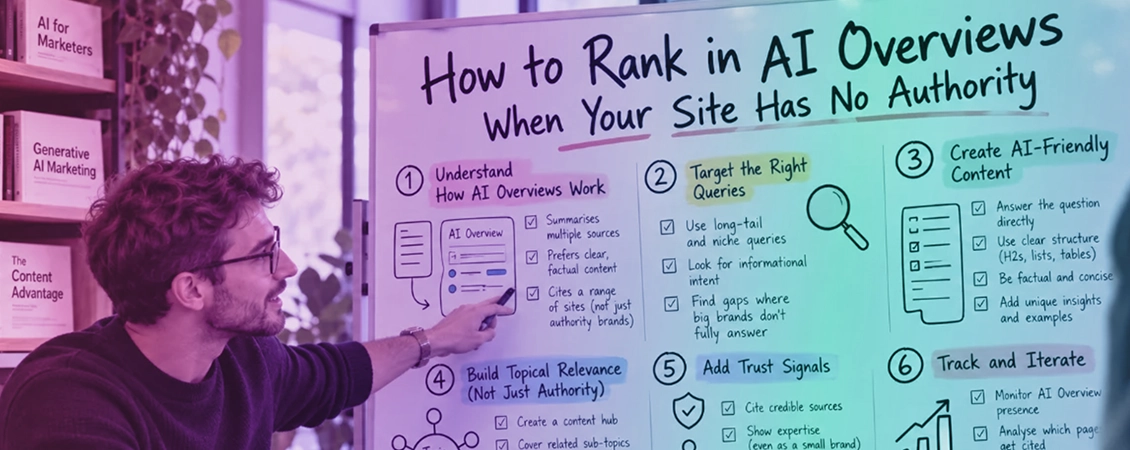
To rank in AI Overviews in 2026, you need three things: a page Google has indexed and can show a snippet from, a section that answers one specific sub-question in its first 40 to 60 words with a named source attached, and a brand that already appears on YouTube, G2 and the third-party lists Google cites in your category. Ranking on page one for the head term stopped being the gate this year. Since March 2026, only 38% of pages cited in AI Overviews rank in the top ten for the query they are cited on.
If you run marketing at a B2B SaaS company, you have read the standard guides: rank well, build authority, add schema, write comprehensive pages, keep them fresh. What you cannot tell is which of that survived the last five months, because Google rewrote the rules in May and most of the guides predate it.
This is the version for a site like ours, with a Domain Rating in single figures. If you want the ChatGPT side of the same problem, we covered it in How to Get Cited by ChatGPT: A B2B Marketer's Playbook for AI Search Visibility.
A page that is indexed and eligible to appear with a snippet in Search. That is the whole entry requirement in Google's guide to optimising for generative AI features, announced on 15 May 2026 in a Search Central post by John Mueller. Everything else in it is either standard SEO or something Google tells you to stop doing.
The stop list is the useful part. No ideal page length. No need to chunk content into small blocks for AI. No special wording, because Google understands synonyms. No special schema.org markup for AI Overviews or AI Mode. No llms.txt file, which does nothing on Google Search. No paid or fabricated mention campaigns, which may breach spam policy.
Google's own summary is that optimising for generative AI search is optimising for the search experience, so it is still SEO. The one positive instruction is to publish what it calls non-commodity content: pages that say something only you could say, rather than assembling what is already on the web.
For a small site, that instruction is the whole game.
No. In July 2025 Ahrefs found that 76.1% of pages cited in AI Overviews also ranked in the top ten for the same query. When it re-ran the study across 863,000 keywords and four million cited URLs in March 2026, the figure was 37.9%, with the rest split almost evenly between positions 11 to 100 and pages outside the top 100.
The mechanism is query fan-out, which Google confirms both surfaces use: a search is broken into several related sub-searches and sources are retrieved for each, so the page cited for "how to reduce SaaS churn" may rank for "churn cohort analysis template" and nothing else. Surfer's study of 10,000 keywords, reported by Search Engine Land on 18 December 2025, found pages ranking across those fan-out queries were 161% more likely to be cited than pages ranking only for the head term.
The caveat: no study breaks this out by Domain Rating, and nobody has published a DR 5 site earning its first citation this way with dates and screenshots. The route exists. Whether it works for a site like ours is something we are testing, not promising.
Ranked lists and comparisons. Seer Interactive's April 2026 study of 5.47 million tracked queries found comparison searches ("X vs Y") triggered an AI Overview 95.4% of the time and question-format searches 85.9%, against 36% of informational queries taken as a whole. On the citation side, DerivateX's July 2026 audit of 1,259 AI Overview citations across 100 "best software" searches found 63% went to third-party lists and 12% to the vendor's own site.
Two things follow. Review-site profiles are a floor rather than a lever: a vendor missing from G2 and Capterra is missing from the lists that take most of the citations. And Reddit matters less for niche B2B software than the general citation leaderboards suggest, with cybersecurity the usual exception.
It is damage limitation rather than growth. Seer's 2026 update gives the cleanest maths on informational queries. A results page with no AI Overview delivers roughly 33,500 organic clicks per million impressions. When an overview appears and your brand is cited, that falls to about 20,700. When it appears and you are not cited, it falls to about 9,400.
So a citation earns roughly 120% more clicks than the uncited pages on the same results page, and still around 38% fewer than a page with no overview at all. Seer also found cited-brand click-through rate halved in late 2025 because impressions more than doubled while clicks stayed flat. Read that as more citations on more queries, and read impressions and clicks as two separate numbers rather than a ratio.
Three things, all of them ordinary editorial discipline. First, answer each section's question in its first 40 to 60 words, directly under a heading phrased the way a person would ask it. That is the length featured snippets have always clustered at, and it is what a retrieval system can lift cleanly.
Second, attach named sources and real numbers. The Princeton and IIT Delhi GEO paper (KDD 2024) found adding citations, quotations and statistics raised a source's visibility in generated answers by around 30 to 40%, and thestacc's July 2026 sample of 1,000 live AI Overviews found pages citing named sources in the body were 2.1 times more likely to be cited. The first was not run on Google and the second is observational, but they point the same way.
Third, refresh substance, not dates. Ahrefs' study of 17 million citations found Google is the least freshness-sensitive of the engines and the average cited page is 2.9 years old. Date-only edits are discounted. New figures, new sources and new sections get pages re-cited.
Stop adding schema as a citation tactic. Ahrefs tracked 1,885 pages that added JSON-LD between August 2025 and March 2026 against 4,000 matched control pages. AI Overview citations moved minus 4.6%, AI Mode plus 2.4%, ChatGPT plus 2.2%, all indistinguishable from zero.
Google removed FAQ rich results from Search in May 2026, so FAQPage markup now earns nothing visible either. Keep Organization and Person markup for entity clarity, and stop there.
Stop rewriting prose into subject-verb-object "semantic triples" because of HubSpot's 642% figure. HubSpot's own write-up says the triples were used alongside schema, backlink and other changes, and it publishes no sample size or baseline.
Getting above zero everywhere. Ahrefs' study of 75,000 brands found branded web mentions correlated with AI Overview visibility at 0.664, YouTube mentions at 0.737 in the December 2025 extension, and backlinks at just 0.218.
The curve is steep. Brands in Ahrefs' top mention quartile averaged 169 AI Overview mentions; the quartile below averaged 14; the bottom half averaged three or fewer.
What the standard guides leave out is that this study only included brands with a Domain Rating over 40 and branded search volume over 800 a month. The thresholds you see quoted are the edge of the sample, not a rule for smaller brands.
Below that line the evidence is thin, and what it suggests is that presence beats volume: complete G2 and Capterra profiles, one real person on YouTube covering your core topic, and inclusion in the third-party lists already cited in your category. Bought mentions and seeded reviews are out; Google's guide says they may breach its spam policies.
Search Console now has a dedicated report. Google launched Search Generative AI performance reports on 3 June 2026 and rolled them out to every site worldwide on 31 August.
The report shows impressions from AI Overviews and AI Mode by page, country, device and date. It does not show clicks, queries or position, and it does not split the two surfaces.
Treat any single citation check as a sample. Ahrefs found AI Overview content changes about 70% of the time for the same query and 45.5% of citations are swapped when the overview regenerates. The cheapest defensible method is 20 to 30 buyer prompts, run five times a week logged out in your target country, logging which URLs are cited and reporting citation frequency rather than presence, reconciled weekly against the Search Console report.
Eligibility first, sub-questions second, off-site in parallel, refresh last. SaaStrix has a Domain Rating of about 4 and effectively no organic rankings, so this is the sequence we are running ourselves, and the one members are working through with us.
Weeks one and two: confirm every important page is indexed and snippet-eligible, confirm the Search Console generative report exists for the property, complete review-site profiles, and use one category description everywhere the brand appears. Weeks two to six: publish comparison and question pages with the year in the title, a 40 to 60 word answer under each heading and named-source numbers, choosing sub-questions from what AI Mode and ChatGPT actually search when you ask them the head question. Weeks three to twelve: one person on YouTube, earned inclusion in existing third-party lists, review velocity.
Weeks eight to twelve: substantive updates to whichever pages earned impressions. Do not expect a citation timeline; the only published one is HubSpot's, and HubSpot is not small.
Ads inside the answer. At Google Marketing Live on 20 May 2026, Google announced new ad formats inside AI Mode, including Highlighted Answers, a sponsored slot that sits inside the AI's own recommendation list and looks like the rest of the answer. By 27 May marketers were already spotting them mid-conversation.
It is a US test for now. If it reaches the UK, the organic best-of citation this whole post is built around loses value, and that is the risk we would most want to be wrong about.
The other change cuts the opposite way. The UK Competition and Markets Authority imposed a conduct requirement on 3 June 2026 letting publishers opt out of AI Overviews and AI Mode without losing rankings, and the EU is running a similar inquiry.
If large publishers opt out at scale, Google's overviews draw more from vendor and mid-tier sites. For once, being small might be the advantage.
No. When Ahrefs re-ran its study across 863,000 keywords and four million cited URLs in March 2026, only 37.9% of pages cited in AI Overviews ranked in the top ten for the same query, down from 76.1% in July 2025.
A page that is indexed and eligible to appear with a snippet in Search. That is the whole entry requirement in the Google guide to optimising for generative AI features, announced on 15 May 2026.
Not measurably. Ahrefs tracked 1,885 pages that added JSON-LD between August 2025 and March 2026 against 4,000 matched control pages, and AI Overview citations moved minus 4.6%, which is indistinguishable from zero. The Google guide says no special schema.org markup is needed for AI Overviews or AI Mode.
It is damage limitation rather than growth. On informational queries in the 2026 Seer Interactive data, a cited brand earns roughly 120% more clicks than the uncited pages on the same results page, and still around 38% fewer than a page with no overview at all.
Ranked lists and comparisons. A July 2026 audit by DerivateX of 1,259 AI Overview citations across 100 best software searches found 63% went to third-party lists and 12% to the vendor site.
Use the Search Console generative AI performance report, which shows impressions from AI Overviews and AI Mode by page, country, device and date. It does not show clicks, queries or position. Alongside it, run 20 to 30 buyer prompts five times a week and report citation frequency rather than presence.
SaaStrix is where B2B marketers become agentic marketing leaders, and you can try it free for five days.