HubSpot's prospecting agent has two settings that explain the difference between agentic and generative AI better than most definitions do. One decides who picks the next email. The other decides whether anyone reads it before it goes.
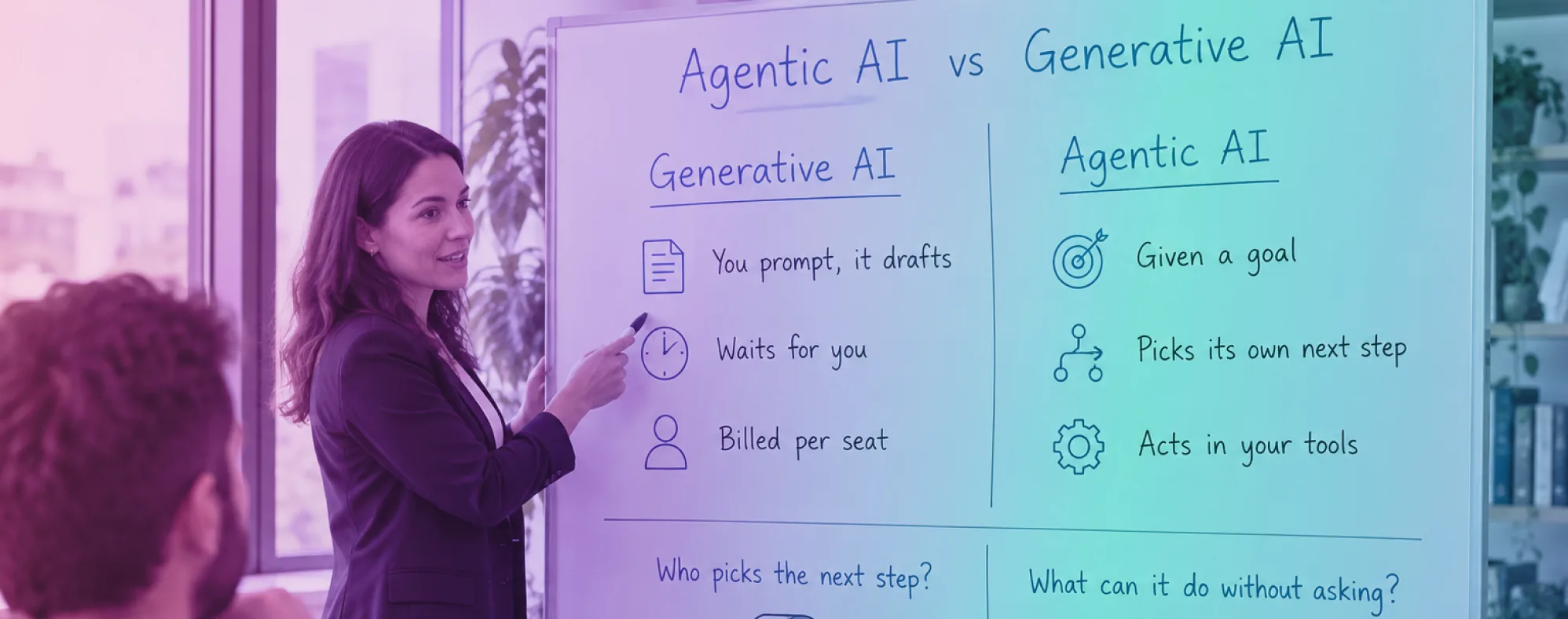
Generative AI produces content when you ask for it. Agentic AI is given a goal, chooses its own next steps across your tools and keeps going until the job is done.
Both run on the same underlying models. For a marketer, the difference that matters comes down to two settings: who picks the next step, and what the system may do without asking.
You already use generative AI every day. Meanwhile every platform in your stack has started calling itself agentic, your CEO has started asking what the team is doing about agents, and none of the vendor explainers say which of those settings you are actually signing off.
This guide starts from the settings and works outwards: where workflows fit, whether the assistant you already pay for counts, which jobs suit each approach, what the adoption figures really measure and who answers for an agent's mistakes in the UK. For agents on their own, see Explaining Agentic AI.
Generative AI creates something new, such as copy, an image or a summary, in response to a prompt. Agentic AI pursues a goal: it plans steps, uses tools, checks results and decides what to do next with limited supervision.
The first describes a capability. The second describes how a system is allowed to operate.
Analysts, consultancies and model builders broadly accept that split. Where they part company is in the wording, and the wording matters more than it looks.
They split on two questions. Does agentic AI need several agents working together? The OECD's February 2026 paper says it generally does; OpenAI and Anthropic both allow a single agent.
And does a fixed, scripted process that calls a model count? Anthropic says it is agentic but not an agent; Google Cloud says it is not agentic at all.
Largely, yes, and the companies building it say so. Google Cloud's own explainer calls agentic AI "a subset of generative AI".
Simon Willison, the developer whose shorthand is now widely repeated, defined the thing in September 2025 as "An LLM agent runs tools in a loop to achieve a goal." The model in the middle is the same one you draft with.
What changes is the scaffolding around the model. An agentic system adds three things a chat window does not have on its own: access to tools that read and change other systems, a loop that lets the model look at a result and choose the next move, and a stopping rule.
OpenAI's guide is precise about where the line falls. Applications that use a model but don't let it control the workflow, "think simple chatbots, single-turn LLMs, or sentiment classifiers", are not agents.
So the distinction is real. It lives in the design and the permissions, while the intelligence underneath is the same.
Two products built on the same model can sit at opposite ends. That is why the useful question for a marketing leader is not "which model is it?" but "what has it been allowed to do?"
The two settings are decision and authority. Decision is who chooses the next step: a person, a script someone wrote in advance, or the model.
Authority is what the system may do without a person approving it: draft only, change records, send, publish or spend. Every marketing AI tool sits somewhere on both, and the two move independently.
HubSpot's Prospecting Agent shows this on one screen. Its help page, updated 14 October 2026, offers "Agent determines steps" or "Configure sequence steps" for outreach, and separately "Review emails" or "Send without review" for sending. Four combinations, one product.
Most of the confusion in vendor marketing comes from treating these as one dial. A tool can be highly adaptive and still unable to send anything.
A rules engine can send ten thousand emails a day and never make a decision. Ask about both settings separately, and ask which one the vendor's case studies actually ran with.
A workflow is the middle ground: a sequence of steps fixed in advance, where a model does some of the work inside each step. Anthropic's guidance describes workflows as systems "orchestrated through predefined code paths", and recommends them over agents whenever the path can be predicted. Most AI marketing that works today runs this way.
Take an illustrative example. A B2B SaaS team wants a weekly digest of competitor pricing changes. A workflow built in Make or Zapier visits five named pricing pages every Monday, asks a model to summarise anything that changed, and posts the summary to Slack.
The path never varies, so nothing about it needs an agent. Now change the brief to "find out why our win rate against one competitor fell this quarter".
The sources aren't known in advance, each finding shapes the next search, and the job only ends when the question is answered. That is agent territory.
Production systems lean heavily towards the first kind. Measuring Agents in Production, a 2026 study by Pan and colleagues, found that 16 of its 20 interview cases used structured workflows "rather than open-ended autonomous planning". We walk through designing one of these step by step in How to Design an AI Marketing Agent Workflow.
Both, depending on the mode you use. The plain chat window is generative: you ask, it answers, it stops.
Since mid-2026, ChatGPT, Claude and Microsoft Copilot each also contain an agent mode in the same product. The label now attaches to the mode and its settings, not the brand.
Two practical consequences follow. You may already be paying for agentic capability, so a separate agent platform is not automatically the next purchase.
And the setting that matters most is the approval mode, which on some plans defaults to letting the assistant keep working without asking. Check it before you connect the assistant to your CRM or your inbox.
Product names and defaults here change month to month; this list reflects each vendor's help pages as of 13 November 2026.
If you'd rather work out those settings alongside 2,100+ other B2B marketers than on your own, join SaaStrix.
Most comparison pages use IBM's five axes: purpose, the user's role, output, autonomy and interaction with other systems. Those describe the technology well. They leave out the five things a marketing leader gets asked about by a CEO or a board when something goes wrong.
Each line below puts generative AI first and agentic AI second.
Reversibility is the row to weigh most. OpenAI's guide already tells builders to rate each tool by "read-only vs. write access, reversibility, required account permissions, and financial impact". The marketing translation is simple: a research agent that can only read is low risk whatever it gets wrong; a system that can send to your customer list deserves the same sign-off you would give a new hire.
Generative AI is better wherever a person was going to review the output anyway. It is cheaper, faster, more predictable and much easier to check, because each answer sits in front of you before anything happens.
Cost and speed. Anthropic's engineering team reported in June 2025 that agents typically use about four times the tokens of a chat interaction, and multi-agent systems about fifteen times. For a subject-line test or a first draft, that extra spend buys nothing.
Stronger evidence. The best causal evidence for AI at work is about generative assistance, not agents. A peer-reviewed study in the Quarterly Journal of Economics, published online in February 2025, followed 5,172 support agents at a software company and found a 15% average rise in issues resolved per hour. It is support work rather than marketing, but nothing comparable exists yet for agents.
Your judgement stays in the loop. A draft cannot embarrass you until someone sends it. A field experiment at the US wine retailer Wine Access, published in January 2026, found no statistically significant difference in gross profit between human-written, AI-written and hybrid emails, with humans still checking the facts. The checking was part of the result.
Agentic AI is better at work where the path cannot be written down in advance, and at work that was not getting done at all. The second matters more than the vendor demos suggest: the most credible B2B results so far come from covering work that had been left undone.
Work nobody was doing. Salesforce's engineering team wrote in April 2026 about lead-nurturing agents aimed at "leads that previously remained idle due to human capacity limits". The company reports over $100 million in pipeline and 1,500 closed SMB deals from its own sales organisation, a figure it has not independently verified. Early versions failed 50% to 60% of the time before the team rebuilt the queueing.
At the agency Major Tom, a HubSpot partner, HubSpot's agent worked 1,000 previously qualified contacts picked from about 7,000 dormant records, and the agency reports 24 meetings, over $750,000 in proposals and one $200,000 deal within a month. Every email there was approved by a rep before it went.
Open-ended research. Investigating an account, a market shift or a drop in win rate, where each finding changes the next question, suits an agent that can choose its own searches.
Always-on monitoring. Watching for a signal and acting within set limits, such as replying to every inbound lead immediately, is tedious for people and natural for a loop.
The right answer differs by job, and usually it is the least autonomous option that still does the work. The verdicts below are our reading of the builder guidance from Anthropic and OpenAI applied to everyday B2B marketing tasks. They are a starting point for your own team, not results from a study.
Two patterns stand out. Every job that touches money or a customer's inbox keeps a person on the authority setting, even when the decision setting is handed to the model. And the strongest case for a full agent is research, the one job where it can do no external harm.
Deciding where the human sits on each of these jobs is easier with peers who have already tried it, and that is what the SaaStrix community is for.
Somewhere between 5% and 86%, depending on which question was asked. The range is the finding: surveys measure intent, experiments, strategic importance or live use, and almost none checks whether the "agents" in question choose their own steps.
The same Content Marketing Institute report found 88% of B2B marketers use AI content tools, so generative use is close to universal. Agentic use is real but mostly early. When a vendor quotes a single adoption figure, the useful follow-up is: which question, asked of whom?
Generative tools are mostly sold per seat. Agentic products are increasingly metered by what they do. The billing unit tells you a lot about how independently the product is designed to work.
ChatGPT Business and Claude Team both start at about £16 ($20) per seat per month on annual billing. Salesforce meters Agentforce in Flex Credits, at £400 per 100,000 on its UK pricing page, with a standard action costing 20 credits.
HubSpot prices its agents in credits at about £8 ($10) per 1,000, with its Customer Agent charged 50 credits per resolved conversation and its Prospecting Agent 100 credits per lead recommended for outreach. Microsoft's Copilot Studio sells 25,000 credits a month for about £160 ($200).
None of these units is a completed marketing outcome. A credit is not a meeting and a recommended lead is not pipeline.
The comparison worth making is total cost per accepted result, including the review time and the failures, against the simpler workflow you would otherwise run. We set out a fuller buyer's rubric in How to Evaluate an Agentic Marketing Platform (Without Buying Salesforce).
Both still get things wrong with confidence. The difference is that a generative mistake sits in a draft until someone catches it, while an agentic mistake can travel. A wrong fact about an account becomes a CRM field, then a targeting choice, then an email.
Neither yet has the evidence its marketing implies. We found no independent study showing that agentic marketing outperforms a well-built generative workflow on B2B results.
McKinsey's April 2026 estimate that agentic AI could power "as much as two-thirds of current marketing activities", and its expectation of campaigns built ten to fifteen times faster, are projections with no published method; its own pilot showed a fourfold gain, and its June 2026 follow-up attributed a similar 60% figure to generative AI alone. Gartner's June 2025 warning that more than four in ten agentic AI projects could be scrapped before 2028 is likewise a forecast, not a tally of failures.
And both inherit your data. An agent fed stale CRM records sends stale emails faster. Major Tom's reps caught changed job titles and departed contacts during review, which is the case for keeping the approval step until the data is clean.
Your business is. UK regulators have been consistent that handing a task to software does not move the liability. The Competition and Markets Authority's guidance on AI agents, published 9 March 2026, says businesses are responsible for their agents even where a third party designed or provides them, and it explicitly covers running marketing campaigns.
The Advertising Standards Authority said in June 2026 that advertisers remain responsible for AI-generated and automatically placed ads. For outbound email, the ICO's rules still distinguish corporate subscribers, where prior consent is not required but you must identify yourself and offer an opt-out, from sole traders and some partnerships, who need consent.
An agent does not create consent that wasn't there. The ICO also opened a call for evidence on agentic AI on 8 October 2026, with a closing date of 20 November 2026, so expect dedicated guidance to follow.
Two points of scope. The CMA guidance is consumer law, so check how it applies to purely B2B dealings.
And the EU AI Act's transparency rules, which apply from 2 August 2026, do not require a visible AI label on every AI-drafted B2B email. We cover liability in more depth in Explaining Agentic AI.
Judge the setting, not the label. Use the least autonomy that does the job, and raise it only when you can show the extra independence produced a better result after the cost of checking it.
If most of your AI use is drafting, editing and analysis: stay generative. Put the effort into better briefs, approved source material and a fixed workflow around the prompts. An agent adds cost here without adding judgement.
If you have a backlog nobody works, such as dormant leads, slow inbound follow-up or unanswered enquiries: this is where a bounded agent earns its keep. Let it choose the steps, keep a person approving every send for the first few weeks, and measure against the zero you were getting before.
If you need open-ended research: use the agent mode in the assistant you already pay for, read-only. ChatGPT Work, Claude and Copilot Cowork all handle multi-step research without a new contract.
If a vendor tells you its product is agentic: ask for both settings in writing. Who chooses the next step, what can it do without approval, and which of those settings were switched on in the case study it is showing you.
The terms will keep shifting. Vendors are already merging chat and agent modes into one box. The two questions underneath, who decides and who approves, will still be the right ones to ask whatever the products end up being called.
Is ChatGPT agentic AI or generative AI?
ChatGPT is both. Its standard chat is generative: you prompt, it responds, it stops.
ChatGPT Work, launched in July 2026, is an agent mode that plans multi-step tasks across connected apps and files and can run on a schedule. Whether a given use counts as agentic depends on the mode and on what you have allowed it to do.
Is agentic AI a type of generative AI?
Mostly, yes. Agentic systems usually run on the same large language models as generative tools, and Google Cloud describes agentic AI as a subset of generative AI. The difference is the surrounding design: tools that act on other systems, a loop that lets the model choose its next step, and permissions that set what it may do without a person.
What is the difference between agentic AI and AI agents?
An AI agent is one system pursuing a goal with tools and some autonomy. Agentic AI gets used two ways: by most vendors as a general label for agent-like systems, and by the OECD's February 2026 paper for systems of several coordinated agents. In everyday marketing use the terms overlap, so ask what a product actually does.
Does agentic AI need human approval?
No, but most agentic marketing products include approval settings, and they are worth using. HubSpot's Prospecting Agent lets you choose between reviewing every email or sending without review.
Claude, Microsoft Copilot Cowork and Gemini all ask before certain actions by default or on some plans. A system with an approval gate can still be agentic if it chooses its own steps.
Is marketing automation the same as agentic AI?
No. Traditional marketing automation follows rules a person wrote in advance: if a lead does this, send that. Agentic AI chooses its next step at runtime based on what it observes.
A workflow that uses a model to write each email is still automation if a person designed every branch. Many products now combine both.
Will agentic AI replace marketers?
The evidence so far points to agents taking on work that was not being done, such as dormant leads and immediate inbound replies, rather than replacing the marketers doing the work well. Projections of agents powering most marketing activity are estimates without published methods. Accountability also stays with people: UK regulators hold the business responsible for what its agents do.
SaaStrix is where B2B marketers become agentic marketing leaders, and you can try it free for five days.