To get your business on ChatGPT, you claim its profile in Business Hub, the dashboard OpenAI opened in beta on 10 November 2026 as part of Businesses in ChatGPT. Once OpenAI verifies you, you can correct your details and see how often ChatGPT mentions you. A claim won't make ChatGPT recommend you more often, though, and OpenAI has said so.
If you run marketing at a B2B company, you've probably been asked how the business shows up in AI answers, and had only third-party estimates to answer with. This is the first time OpenAI has offered its own count. Its announcement explains the product but not what a marketer has to do, so this guide covers the setup steps, where UK companies stand, and what the numbers mean.
Businesses in ChatGPT is the name OpenAI gives its new listings programme, which lets a company take ownership of its profile in ChatGPT and keep it accurate. It went into beta on 10 November 2026. OpenAI puts ChatGPT's weekly audience at 1.2 billion people, and the programme has four parts:
Both the Hub and the agents cost nothing at launch, according to Digiday, though OpenAI hasn't ruled out charging later.
Don't confuse any of this with ChatGPT Business, the workplace subscription OpenAI sells to teams. Paying for seats there has nothing to do with claiming a profile here.
You get your business on ChatGPT by claiming it at chatgpt.com/business-hub, proving you represent it, and waiting for OpenAI to review the claim. The steps below come from OpenAI's announcement and launch-week walk-throughs. We haven't claimed our own profile yet, so read them as the documented route and not as our test notes.
1) Open Business Hub. Go to chatgpt.com/business-hub. It also sits in the ChatGPT sidebar.
2) Sign in. Use the ChatGPT account that will own the profile long term.
3) Find your business. Type in the company name and pick it from the results, or create the listing if it isn't there.
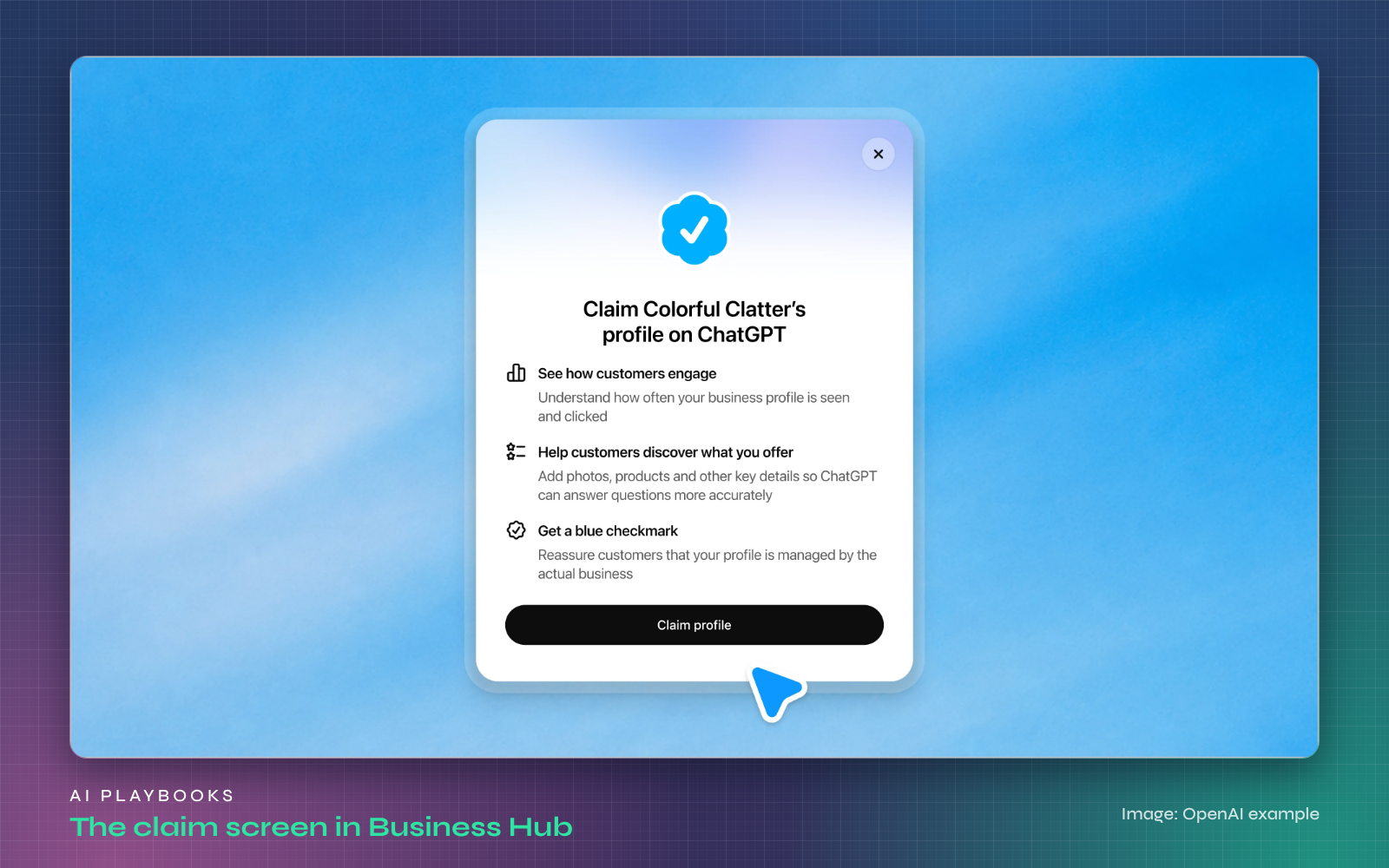
4) Start the claim. You'll see a screen listing what verification gets you. Select "Claim profile".
5) Choose how customers reach you. You pick one of three: physical location, online store or service. OpenAI requires the category to be accurate, so don't register as an online store to get in early.
6) Verify. You prove you represent the business with a code sent to its phone or email, a DNS record on its domain, or a Shopify connection. OpenAI then checks a government ID before it lets you edit.
7) Wait for the decision. OpenAI reviews what you've submitted and emails you the outcome.
Filling this in takes minutes. Verification takes longer in most B2B companies, because the DNS settings and the main company inbox usually belong to IT, finance or a web agency. Brief them before you start.
Partly. As of 12 November 2026, UK online stores can go through the claim, but the "service" business type was marked "coming soon" in launch-week tests. That's the category most B2B software and service companies belong in, so most UK B2B teams should expect a waitlist for now.
The evidence is secondhand, so here it is. UK agency Tilio reported the service option as coming soon in its UK account on 10 November, with the online store option selectable. Testers in Spain and Brazil reported waitlists the same week.
OpenAI plans to open more markets and categories and hasn't put a date on either. Do the steps anyway. A waitlisted claim puts you in the queue, and the verification groundwork is the same whenever access opens.
We'll update this section, and its date, when the status changes.
No. A claim isn't meant to change how often ChatGPT brings a business up, according to Benji Shomair, OpenAI's VP of monetisation, who told Digiday that ChatGPT has to stay objective.
He did say clearer information could help a business surface in more relevant conversations. That promises better matching, not more appearances, so treat the profile as a way to correct the record. It doesn't replace publishing.
The more useful news is a definition. OpenAI also told Digiday what it counts: for an online business, ChatGPT has to reference the company's website for a mention to register. Your brand name on its own doesn't.
Our view is that this definition matters more than the listing. If you want your business recommended by ChatGPT and other AI assistants, the lever is pages they can cite: pricing pages that answer first, comparisons, integration pages, and a clear page on who you serve. A well-known brand whose website rarely gets cited will see a small number in its dashboard.
We cover that work in How to Get Cited by ChatGPT: A B2B Marketer's Playbook for AI Search Visibility.
Before your claim is approved, the only check is manual. Ask ChatGPT the questions your buyers ask, with web search switched on, and note whether it names you and which pages it cites. Once you're approved, Insights gives you OpenAI's own figures for the last 7 or 28 days: mentions, profile views, clicks to your website and discovery topics.

The numbers appear once activity passes a threshold OpenAI hasn't published. Read them with four cautions.
A click isn't a visit. The Hub's own help text says clicks don't confirm website visits or conversions. Report them as clicks, never as traffic, leads or pipeline.
Expect low click rates. PPC Land worked out the click rate on two dashboards that were shared publicly on launch day, and both came to roughly 3.5% of mentions. The larger had 690 mentions and 24 clicks in 28 days, and the smaller had 28 mentions and 1 click.
That's two dashboards, not a benchmark. OpenAI's own example dashboard implies about 35%, and we wouldn't use either figure as a target yet.
Watch trends, not totals. Compare the same 7-day or 28-day window over time.
You get themes, not prompts. Insights shows discovery topics. It doesn't show what people typed, and it says nothing about competitors.
A Business Agent is a branded chat that a company runs inside ChatGPT, clearly labelled as that company's AI. Someone opens your profile, starts a chat, and gets answers built from the instructions and product information you've supplied. Only ecommerce and online service businesses in the US that OpenAI deems eligible can have one at launch, and there's no timetable for other countries.
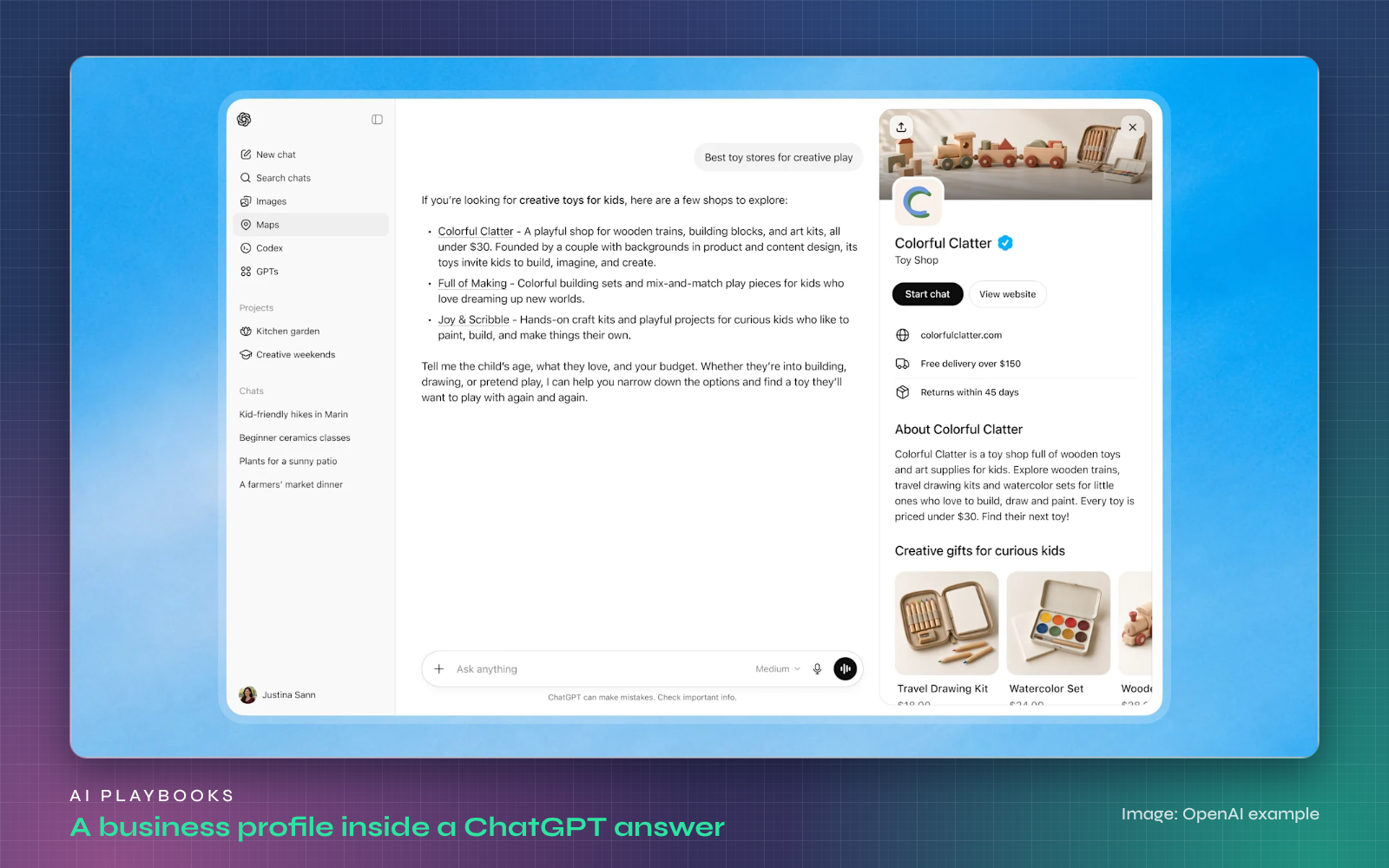
Three details matter if you're planning ahead. Digiday reported that agents are built only from what the business supplies, that you can't bring your own agent, and that purchases complete on the brand's own website. OpenAI says agent chats are labelled and kept apart from ChatGPT's own answers, and that businesses don't see users' conversations.
Whether B2B software counts as an online service business hasn't been established. If it does, the obvious use is handling the questions a buyer wants answered before agreeing to a sales call. So the instructions you'd give an agent are worth drafting early: who the product suits, where your plans diverge, and how to answer when someone asks for a feature you lack.
Four jobs are worth doing now, and none of them needs an approved claim.
Line up verification. Find out who controls your DNS, the main business phone line and the main inbox, and brief them.
Audit how ChatGPT describes you. Ask it what your company does, who it's for and what it costs, and ask for the source behind every fact.
Make your facts match everywhere. Your website, review listings and LinkedIn page should agree on pricing, plans and who you serve.
Record a baseline. Note your ChatGPT referral sessions in GA4 for the last 7 and 28 days, so you have a before.
Managing how your company shows up inside AI platforms is becoming a named job. In most B2B teams it has no owner yet, and that's an opening for the marketer who can measure it and explain it to leadership. It's the kind of work an agentic marketing leader picks up first.
Members of SaaStrix, the AI-native marketing community, get the full Businesses in ChatGPT Playbook for Marketers. It includes three copy-and-paste prompts: one to audit how ChatGPT describes you, one to find your content gaps, and one to draft the brief for your future Business Agent. The playbook is inside the community.
How do I rank in ChatGPT?
ChatGPT doesn't have a ranking you can climb the way Google does. It names and cites sources it can read and has reason to trust, so the work is making your pages easy to cite and getting described consistently on other sites. Claiming a profile in Business Hub doesn't change how often ChatGPT recommends you, according to OpenAI's Benji Shomair, speaking to Digiday.
How do I get cited by ChatGPT?
Publish pages that answer a buyer's question in the first lines, keep them current, and make sure AI crawlers and Bing can reach them. What other sites say about you matters more than most teams expect. Our full method is in How to Get Cited by ChatGPT: A B2B Marketer's Playbook for AI Search Visibility.
Why does ChatGPT recommend my competitors and not me?
Usually because the sites ChatGPT relies on describe your competitors in the words buyers use, and describe you differently or not at all. Ask ChatGPT for the sources behind its shortlist and you'll see which pages it leaned on. We explain the pattern in Why AI Recommends Some Brands and Not Others.
How do I track whether ChatGPT recommends my SaaS product?
Run the same set of buyer questions through ChatGPT on a schedule, and log whether you're named and which pages are cited. Once your Business Hub claim is approved, Insights adds OpenAI's own count of mentions and clicks. For coverage across other AI assistants, see AI Visibility Tools for B2B SaaS: Which to Buy and What the Numbers Mean.
Is Businesses in ChatGPT free?
Yes, for now. Digiday reported on 10 November 2026 that neither Business Hub nor Business Agents costs anything at launch, and that OpenAI's Benji Shomair didn't rule out a paid model later. Sponsoring an agent through ChatGPT Ads is the paid part.
What's the difference between ChatGPT Business and Businesses in ChatGPT?
ChatGPT Business is OpenAI's paid workplace subscription for teams. Businesses in ChatGPT is the listings programme that lets a company claim its profile, correct its details and see how often ChatGPT mentions it. They're separate products, and buying ChatGPT Business seats doesn't claim your profile.
Can B2B software companies use Business Agents?
Not yet in the UK, and it isn't settled in the US. Business Agents launched in the United States only, for ecommerce and online service businesses that meet OpenAI's eligibility rules, and OpenAI hasn't said whether B2B software counts as an online service business. It plans more markets and categories and has given no dates.
SaaStrix is where B2B marketers become agentic marketing leaders, and you can try it free for five days.