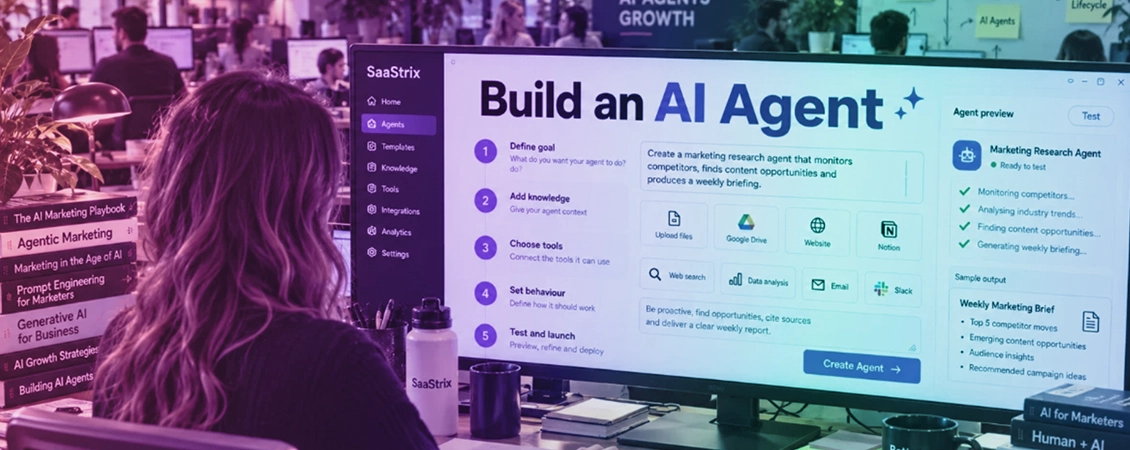
We drew a weekly competitor monitoring agent end to end. Seven of its eight steps turned out not to need an agent. Designing one of these starts with the job rather than the agent: write down what you already do, automate the path you can predict, and give the model discretion only at the step where the path genuinely varies.
That sequence matters more than the tool you build it in. A US Census Bureau working paper published in April 2026 found sales and marketing is the most common function where AI lands inside adopting firms, at 52%, while 66% of users rely on it purely to augment existing tasks. Plenty of teams have the tools and far fewer have a designed workflow.
For the ground floor on what an agent is and what one can do, we covered that in AI Agents for Marketing: 5 Examples B2B Teams Can Use.
The distinction that matters comes from Anthropic's engineering team, in a post published on 19 December 2024 that the field has since standardised on. A workflow orchestrates models and tools through predefined code paths. An agent lets the model direct its own process and choose its own tools.
The dividing line is control flow: who decides what happens next, your code or the model.
OpenAI's practical guide to building agents gives the test. Prioritise work that has previously resisted automation, and look for three signs: decisions needing nuanced judgement, rulesets grown too intricate to maintain, and heavy reliance on unstructured data. Absent those, it says a deterministic solution may be enough.
Gartner has a blunter version. In June 2025 its senior director analyst Anushree Verma named the practice of agent washing, rebranding assistants and chatbots as agentic, and said many use cases positioned as agentic today do not require agentic implementations.
The working rule: if you can write the rule, write the rule. The agent earns its place where writing the rule is the thing that keeps failing.
Start from the written-down version of the job. OpenAI's guidance is to build routines from documents you already have, standard operating procedures and policy documents, rather than from a blank page, and to make every step correspond to a specific action or output.
That inverts how most teams approach this. Instead of asking what an agent could do, you read the process you already run and cut it at the joints. Where no written version exists, producing one is the first output of the exercise, and usually the reason the job was never automated.
Then mark every step as one of three things: predictable, needing judgement, or carrying real risk. Predictable steps become ordinary automation. Judgement steps get a model with a narrow brief.
Risky steps get a human with a decision to make, rather than a prompt instruction telling the model to be careful.
This method is ours. There is no authoritative decomposition framework to borrow, which is worth knowing before someone sells you one.
Take weekly competitor and category monitoring. What follows is a reference design rather than a case study, so no results are attached to it.
Eight steps:
Step two does more work than any other and is the one most teams skip. Comparing before you pay for inference means the model only ever sees what changed. That improves the output, because there is less to wade through, and cuts the cost at the same time.
At step eight, and nowhere else.
Steps one to seven have a knowable order and a checkable output, which is the primary sources' own test for a path you should hardcode. Step eight does not. When a pricing page changes and you want to know what it means, nobody can specify in advance how many sources that takes or which ones.
That is the shape of work model-directed choice is for: bounded, human-triggered, with a step budget and no ability to write anything anywhere.
Here is where we would put our money. Build the seven deterministic steps and leave the eighth until the rest is running reliably. The brief carries most of its value before the agent is involved at all, and most of the teams doing this in reverse have an impressive demo and no weekly output.
Three checkpoints, each with a decision attached. Review without a decision attached is a queue, not a control.
Monthly, somebody reviews the source register and decides whether it is still the right competitor set. Weekly, somebody approves the brief before anything leaves the channel it posted to. And any change classified as pricing or packaging on a named competitor goes to a named person before it can appear in a recommendation, because that is the category most likely to trigger an expensive internal response.
Explicitly not a checkpoint: reading the fetched pages. That costs the reviewer's attention at the point where it saves nothing.
There is also a distinction between approving an output and approving an action, and it is not cosmetic. n8n, the open-source workflow automation tool, documents human approval before a specific tool runs, showing the reviewer which tool the agent wants to call and with what parameters. For anything irreversible, reviewing the output arrives after the damage is done.
Because the human stops reading them properly, and this is measured.
In a study published in Radiology on 2 May 2023, Dratsch and colleagues had 27 radiologists read 50 mammograms with categories supposedly suggested by an AI system. Among the five most experienced readers, accuracy fell from 82.3% when the suggestion was right to 45.5% when it was wrong. Experience slowed the effect rather than preventing it.
The more useful finding for anyone designing a checkpoint is in the International AI Safety Report 2026, published on 3 February 2026, which reports a randomised experiment with 2,784 participants. People were less likely to correct an AI's error when correcting it took more effort than accepting it.
So the cost of correcting is a design variable. A checkpoint offering a finished brief and an approve button will be approved. Post in draft, make rejecting a single item a one-click action with a reason attached, and feed that reason into the next run.
The withholding is the half people get wrong. Anthropic's context engineering guidance argues for the smallest set of high-signal information that produces the behaviour you want, not the largest.
For this workflow that means four things: the source register, the current positioning document, last week's brief, and a list of claims nobody may make. Plus two rules stated in the prompt.
Every claim cites a URL fetched in that run. Observation and inference go in separate fields, so that ‘they posted a VP Enterprise Sales role’ and ‘they are moving upmarket’ never arrive as the same kind of statement.
What you withhold is tool access. The steps that classify, assess and draft hold no tools at all: text in, text out. Those steps are reading competitor pages and review sites, content a third party controls.
Separate the step that reads untrusted content from the step that has the ability to act, and a hijacked step has nowhere to go.
Build the evaluation set before you build the workflow. Twenty archived pairs of weeks where you already know what changed, re-run on every prompt change and every model change. Without one, a model migration is discovered in production.
What a good brief looks like is worth writing down too. Every item traceable to a URL fetched in that run. At least one thing a marketer who already knows the space did not know, and zero items they would be embarrassed to repeat to a colleague.
Then the test almost nobody runs: plant a known-wrong item once a month and see whether the reviewer catches it. If your catch rate is near zero, you have paperwork rather than a control.
Four things, and only one of them is loud.
A competitor moves their pricing page, the fetch returns a 404, and the brief cheerfully reports no pricing changes that week. Absence of evidence rendering as evidence of absence is the most under-built control in this class of workflow. Make the run fail loudly when a source does not return what it should.
The model underneath you changes. Retirement produces an error you will notice. Substitution does not: the call still returns a 200, the structured output quietly stops matching your schema, and nothing in the logs warns you.
The workarounds you wrote in week one become dead weight by month six, because they encode assumptions about what the model could not do, and nobody removes them.
And the reviewer gets worse. The International AI Safety Report 2026 cites a clinical study where detection rates fell by around six percentage points after months of AI-assisted practice. The skill you stopped using is the one your checkpoint depends on.
When a plain rule would do, which is most of the time. When the metering makes it expensive: platforms that bill per action charge you for looking as well as finding, so an agent that wakes up to check whether anything happened is paying to discover that nothing did. And when oversight cannot realistically function, in which case the answer is to remove the capability rather than put an approval click in front of it.
One more, on where you build it. On 3 June 2026 OpenAI announced it is winding down Agent Builder, its own drag-and-drop agent canvas, unavailable from 30 November 2026, roughly eight months after launch. Anything built on it has to move.
Own the job, the design and connections that port between runtimes, and treat any vendor's canvas as rented. If you are choosing the automation platform underneath, we compared the main three in Zapier vs Make vs n8n: Which Is Right for B2B Marketers?.
A marketing job broken into steps, where ordinary automation handles the steps you can predict and a model is given discretion only at the step where the path varies. In the weekly competitor monitoring example in this post, seven of the eight steps did not need an agent.
Control flow. A workflow orchestrates models and tools through predefined code paths, while an agent lets the model direct its own process and choose its own tools. The distinction comes from a post by the Anthropic engineering team published on 19 December 2024.
When writing the rule is the thing that keeps failing. The OpenAI practical guide to building agents names three signs: decisions needing nuanced judgement, rulesets grown too intricate to maintain, and heavy reliance on unstructured data. Absent those, a deterministic solution may be enough.
At checkpoints with a decision attached. In the reference design here there are three: a monthly review of the source register, weekly approval of the brief before anything leaves its channel, and a named person checking any pricing or packaging change on a named competitor before it appears in a recommendation.
Because the reviewer stops reading them properly. The International AI Safety Report 2026 reports a randomised experiment with 2,784 participants in which people were less likely to correct an AI error when correcting it took more effort than accepting it. Make rejecting a single item a one-click action with a reason attached.
Build the evaluation set before you build the workflow: twenty archived pairs of weeks where you already know what changed, re-run on every prompt change and every model change. Then plant a known-wrong item once a month and see whether the reviewer catches it.
SaaStrix is where B2B marketers become agentic marketing leaders, and you can try it free for five days.


.svg)