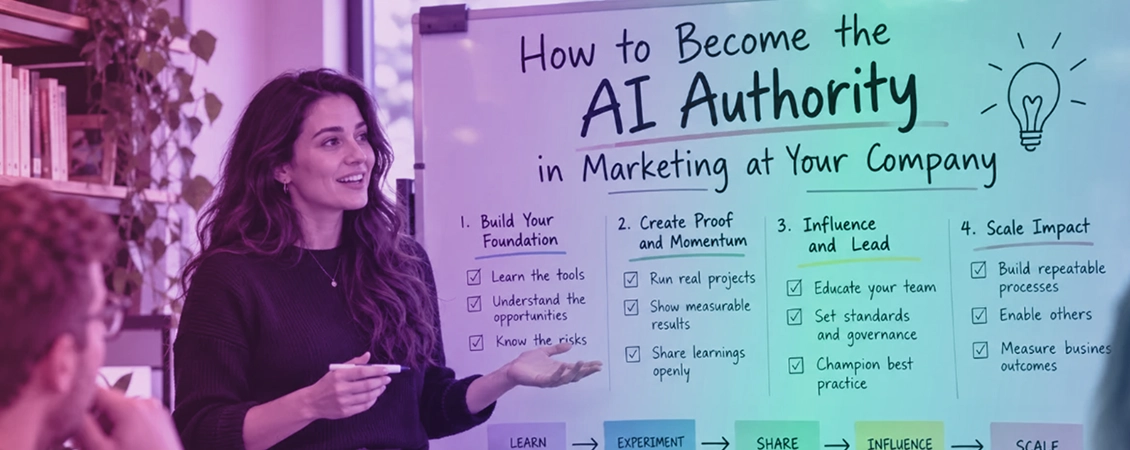
The AI authority in marketing (what Google calls the AI marketing champion) is the person who turns scattered AI use into a marketing operating system: choosing where AI goes, redesigning the workflows it runs in, setting the guardrails, proving the commercial result and making the rest of the team capable without them. Nobody is appointed to this. You claim it by doing it.
Eighty per cent of people say AI has made them personally more productive. Only 37% of their organisations can find that productivity in the profit line, and the number has not moved in a year. Somebody at your company is going to be asked to explain that gap.
This guide is about making sure it is you, and about what the role involves once you have it. If you are reading this you probably have plenty of AI tools open in plenty of tabs, you use them well, and nobody has asked you to own any of it. That is where almost every experienced B2B marketer is right now. It is also the opening.
An AI authority in marketing owns the outcome of AI for the marketing function, not the tools. They decide which work AI should touch, rebuild that work so AI and people each do the part they are good at, set the rules for what AI may and may not do, measure the result in terms a CFO recognises and teach colleagues to run the system without them.
Google's Think platform put a name on the role in March 2026. Jim Lecinski, the Kellogg professor who wrote the piece, describes an AI marketing champion as rarely a new hire, usually holding the role alongside an existing job, fluent in both marketing and technology, and owning a measurable portfolio of use cases. His diagnosis of why most marketing AI stalls: everyone owns a slice and nobody owns the outcome.
OpenAI's champion framework is blunter. A person can be excellent at using AI personally and still fail to help an organisation adopt it. What the authority does that a heavy user does not: judgement about where AI creates value, workflow design, governance, measurement, enabling others and talking upward in the language of revenue and cost. Prompting sits inside that list, a long way down it.
Marketing needs an AI authority now because adoption has outrun ownership. McKinsey's State of AI 2026 (1,719 respondents, fielded May to June 2026) found 80% of people report improved personal productivity from AI while only 37% of organisations attribute any EBIT impact to it, a figure unchanged from 2025. The tools are in use. The value is going uncaptured.
The marketing-specific picture is the same shape. Gartner's 2026 CMO Spend Survey (401 marketing leaders, fielded January to March 2026) found 70% of CMOs say becoming an AI leader is a critical goal for the year, yet only 30% report mature AI readiness and 70% admit their internal processes are not ready to implement AI at scale. Those CMOs are spending an average of 15.3% of their marketing budget on AI they are not organised to use.
Marketing AI Institute's 2025 State of Marketing AI survey (1,882 respondents) found only 25% of marketing teams had an AI roadmap. Asked who owned AI adoption for marketing, 17% said nobody did. Both surveys skew towards larger, more AI-engaged organisations, which makes the gap more striking. If the companies furthest ahead have not filled the role, yours has not either.
Your CEO is measuring marketing on whether AI produces financial impact, and most CEOs currently think it does not. Boathouse's Fifth Annual CEO Study (150 US CEOs at companies from $250m to over $1bn revenue, surveyed January 2026) found 60% now view marketing as a cost centre, up from 35% a year earlier. Only 6% would give their CMO an A grade for AI capability.
Only 13% of those CEOs are very confident marketing can demonstrate financial impact at all. Zoom out to the whole business and the pressure is the same. PwC's 2026 Global CEO Survey (4,454 CEOs across 95 countries) found 42% name transforming fast enough to keep up with technology as their biggest concern, while only 12% say AI has delivered both revenue and cost benefits and 56% say it has delivered neither.
Read those two studies together and the brief is written for you. The people running your company want someone in marketing to own AI and prove it pays, and they are grading the function badly on exactly that. A grade that low is a vacancy for the person who can raise it.
The career case is that AI ownership is now the fastest-appreciating asset a marketer can hold. The American Marketing Association's 2026 State of Marketing Careers report (1,412 practitioners, surveyed December 2025 to January 2026) found the share of marketing job postings mentioning AI doubled in 2025. Marketers rated AI the single most important skill for the next five years, and new titles such as AI workflow designer are appearing while execution roles decline.
Across all sectors, PwC's 2026 AI Jobs Barometer (over one billion job adverts, 27 countries) puts the average wage premium for roles requiring AI skills at 62%, up from 57% a year earlier. That figure is not marketing-specific and we are not going to pretend it is. The direction is what matters, and the direction in marketing matches it.
The clearest single example is Zapier. In July 2026 the company promoted its CMO, Dan Slagen, to the dual title of Chief Marketing Officer and Chief AI Transformation Officer, after he rebuilt his own team around AI (more on how below). The title followed the work. That is the order it happens in.
If you leave it, someone else takes it, and the reshaping of marketing work continues either way. Challenger, Gray & Christmas recorded 54,836 announced US job cuts in 2025 where employers cited AI, and AI was the leading stated reason for cuts for five consecutive months to July 2026. Marketing is not broken out in that data, and Challenger itself warns that employer attribution is not the same as cause.
The more useful finding is that the fear has run ahead of the facts. McKinsey's 2026 survey found only 13% of respondents say AI makes them anxious about their career, and actual AI-related workforce reductions over the past year (14%) were less than half what respondents had predicted a year earlier (32%). Marketing and sales was among the functions where the prediction most overshot.
Roles are being redesigned faster than they are being deleted. The question is whether you are the one doing the redesigning.
A power user makes their own work faster. An authority changes how the team's work runs. Microsoft's 2026 Work Trend Index (20,000 AI-using knowledge workers in ten countries) found the difference shows in behaviour: its most advanced users were twice as likely as everyone else to jointly identify business processes suitable for AI (63% against 32%) and to share techniques, agents and mistakes with colleagues (61% against 36%).
The same study found organisational factors such as culture and manager support explained 67% of the variation in reported AI impact, against 32% for individual factors. Microsoft calls that an association rather than a cause, and so do we. Personal skill is necessary and nowhere near sufficient.
We find it useful to think of five rungs. A user has the tools. A power user prompts well and produces faster. A workflow designer changes how a recurring marketing job gets done. An authority chooses priorities, sets standards, measures value and teaches the team. An agentic marketing leader designs systems in which people and AI agents execute marketing work together. The decisive step is between the second rung and the third, where tool skill becomes organisational leverage. It is the step almost everyone stalls at.
The value comes from redesigning the work, not from adding AI to it. This is the strongest finding in the current evidence. McKinsey's 2026 survey found that nearly three-quarters of its AI high performers (the 6% attributing at least 5% of EBIT to AI) have fundamentally redesigned workflows around AI, against roughly a quarter of everyone else. In the previous year's survey, workflow redesign had the strongest relationship with EBIT impact of 25 organisational attributes tested.
Gartner's marketing data says the same thing from the other side. Among 402 marketing leaders it surveyed in late 2025, only 5% of those using generative AI purely as a tool reported significant business-outcome gains.
In practice, "I use Claude to draft faster" is a power-user statement. "We cut campaign build time by a third by rebuilding the brief-to-launch process with AI at two stages and a human check at a third" is an authority statement. The second one is what gets you the mandate. The first is what everyone can already say.
Pick the workflow with the strongest combination of commercial value, frequency, a measurable baseline, usable data, easy human verification and low risk. Do not pick the most impressive demonstration. Score candidates on those six dimensions and take the winner, even if it is a reporting process rather than something glamorous.
The reason to be disciplined about this is that returns vary enormously by application. A randomised field experiment on a cross-border retailer (published as a preprint in 2025) found a pre-sale chatbot lifted sales by 16.3%, while AI-generated marketing messages lifted clicks by 3.0%, orders by 2.8% and purchase value by 1.6%. Same company, same technology, a tenfold difference in effect depending on where it was pointed.
McKinsey's 2026 survey found revenue gains from AI are most often attributed to marketing and sales, ahead of product and engineering. So the money is in your function. The authority's first job is to work out which part of it, and the honest answer is usually a bottleneck involving customer data, hand-offs and waiting, rather than a blank page that needs a first draft. We covered the use cases themselves in our AI in marketing field guide, so we will not repeat them here.
You prove it with a before-and-after on the workflow you chose, reported in a hierarchy that ends in money. Adoption comes first (who is using the new process, how often), then operating outcomes (cycle time, cost per asset, hours released), then quality (rework rate, errors, brand compliance), then commercial impact (pipeline, conversion, cost per opportunity), with a risk line alongside (data incidents, unapproved tools, escalations).
Most marketing teams stop at the second layer. Gartner's 2025 CMO Spend Survey (402 respondents) found that among marketing leaders reporting a return on generative AI, 49% cited time efficiency, 40% cost efficiency and 27% extra capacity. Those are real, and they are also exactly what a CEO who thinks marketing is a cost centre expects to hear. The authority's job is to connect them to the layer above.
Measure honestly, including when it hurts. HubSpot publicly revised the resolution rate of its Breeze customer agent from 70% to 65% once it had been measured across more than 8,000 activations. A revised number that holds is worth more upward than an impressive one that does not, because it tells the people above you that your other numbers can be trusted too.
Your first 90 days are about earning the mandate, not exercising it. The moves the evidence supports, in order: secure a named sponsor above you and agree one commercial outcome, one efficiency outcome and one risk boundary; map how AI is already being used in the team, including the unofficial use; pick one workflow using the scoring above; redesign it with explicit human checkpoints; run it against the baseline; document it so a second person can run it; teach that second person; then take the result upward with a prioritised list of what comes next.
The sponsor matters more than the workflow. Prosci's research on AI implementations (1,107 professionals) found 43% cite insufficient executive sponsorship as a barrier and over half of managers cite unclear success metrics. That is why the outcome and the risk boundary are agreed on day one, not day sixty. And a second person matters more than a second workflow: one person achieving a result proves skill, a second person repeating it proves capability.
This is the organisational layer of the role. If you want the underlying tactical sequence for getting AI into daily marketing work, that is a separate piece: How to Use AI for Marketing: A 90-Day Playbook for B2B SaaS Marketers.
You scale by demonstrating, then systematising, then multiplying. The best documented marketing example is Zapier. In February 2026 Dan Slagen brought an outside AI power user in to show his marketing team what non-technical marketers elsewhere were building with coding agents, then ran a three-week onboarding followed by a two-week build-a-thon in which every marketer shipped something and recorded a walkthrough.
Three tiers of builders emerged on their own. The team then built a shared "marketing brain", a department-level context system, so nothing learned by one person was lost to the rest. Slagen moved his own Slack communication from 50% public to 96% public, and summarised the whole thing by saying the obstacles were behavioural, not technical.
HubSpot ran the same idea as a target: 80% weekly active AI usage across the company by the end of 2025, tracked openly by team and tool, backed by 20 company-wide AI learning days. Both companies are reporting on themselves, so treat the numbers as accounts rather than audits. The pattern is what transfers: visible leadership use, public building, a shared library of working systems rather than a prompt bank, and the recurring demos and showcases the AMA's 2026 report recommends to every CMO.
The failure mode to avoid is becoming the bottleneck. BCG's 2025 workforce survey (10,635 employees) found employee positivity towards generative AI was 15% without strong leadership support and 55% with it. Your influence grows when the team can run the systems without you. The authority who guards the tricks is a power user with a bigger title.
You need enough fluency to know when legal, privacy, security and brand colleagues have to enter a workflow, and no more. You are not the company's lawyer. The trigger points are what you own, and three are live right now.
First, the EU AI Act's Article 50 transparency obligations have applied since 2 August 2026: people must be told when they are dealing with an AI system such as a customer-facing chatbot, providers must machine-readably mark generated content, and deepfakes must be visibly disclosed. The Digital Omnibus delayed the high-risk provisions to 2027 and 2028 but did not delay Article 50, and plenty of teams have assumed it did. It is also wrong to say all AI-generated marketing copy now needs a label; the law is narrower than that.
Second, in the UK the advertising codes are media-neutral. CAP's position is that existing rules apply however an ad was made, and disclosure does not cure a misleading claim. Third, the ICO applies data protection law to any personal data used to train, test or run an AI system, with an absolute right to object to profiling for direct marketing. Copyright rules for AI-generated assets differ between the UK and the US, so a global campaign needs both checked. Route the questions early and a promising pilot will not die in month three because compliance met it for the first time in month two.
The role is never finished because the floor keeps moving. The World Economic Forum's Future of Jobs Report 2025 (1,043 companies, 14.1 million employees) expects 39% of workers' core skills to be transformed or outdated by 2030. LinkedIn's Work Change Report projects 70% of the skills used in most jobs will change in the same period. Zapier had to rebuild its AI fluency rubric within a year of publishing it because, in its own words, the floor moved.
Nobody has found a reliable "half-life" for AI marketing skills, and we are not going to invent one. What the evidence does show is how the people who stay current do it: structured, peer-visible practice. Demos, showcases, build sessions, shared libraries of working systems, and a room where someone says "this stopped working last month" before you find out the hard way. Solo consumption of content does not produce it. Cohorts and communities do.
This is the part of the role that looks least like a job description and most like a habit. It is also where the AI authority stops being a title you hold and becomes the way you work.
SaaStrix is where B2B marketers make exactly this move, from the person who uses AI well to the person who owns how AI changes marketing at their company. The community is built for the marketer this guide is written for: experienced, and missing the organising point of view that turns a stack of tools into a system.
Every layer this guide describes exists inside the community, run live rather than written up after the fact. AI Labs is a stream of practical AI content for B2B marketers, including workflow guides and prompt libraries, which is the shared library of working systems from the section above. The Operations zone is where members compare the workflows they have redesigned and the guardrails they set, which is the peer-visible practice that keeps the role current. Sprints are short, focused courses, including Claude AI for Marketers.
Then there is the part no course supplies. A monthly live Q&A with founder Danny Asling, a CMO with 15+ years in B2B SaaS marketing leadership, and a private inbox for the questions you would rather not ask in front of your own team: the workflow that is not working, the sponsor who has gone quiet, the number you are not sure you can stand behind. Members come from brands including Pepsi, Uber, Google, Gong and HubSpot, and most of them are working on the same problem you are.
Membership is £29.95 a month or £299.95 a year, and you can join directly here if you already know this is the room you need.
What is an AI marketing champion?
An AI marketing champion is the person accountable for the outcome of AI across a marketing function: choosing use cases, redesigning workflows, setting governance, measuring commercial impact and enabling colleagues. The term was popularised by Jim Lecinski on Google's Think platform in March 2026. In this guide we use AI authority in marketing to mean the same role, claimed from inside the team rather than appointed from above.
Do I need a technical background to be the AI authority in marketing?
No. Zapier's marketing team rebuilt itself around AI with non-technical marketers building apps and dashboards using coding agents, and Google's description of the champion role stresses fluency in both marketing and technology rather than engineering skill. What you need is judgement about where AI creates value, the discipline to measure it and the willingness to teach.
How is an AI authority different from a power user?
A power user makes their own work faster with AI. An authority changes how the team's work runs, sets the standards for it, proves the commercial result and makes colleagues capable without them. Microsoft's 2026 research found its most advanced users were twice as likely to jointly identify processes for AI and to share techniques with colleagues.
What should I measure to prove AI is working in marketing?
Report in a hierarchy: adoption, then operating outcomes such as cycle time and cost per asset, then quality, then commercial impact such as pipeline and cost per opportunity, with a risk line alongside. Most teams stop at time saved. The authority connects time saved to the revenue and cost figures a CEO recognises.
Does the EU AI Act affect marketing content?
Yes, in specific ways. Since 2 August 2026, Article 50 requires disclosure when people interact with an AI system, machine-readable marking of AI-generated content by providers, and visible labelling of deepfakes. It does not require a label on every piece of AI-assisted marketing copy. UK advertising rules apply to AI-made ads exactly as they do to any other.
How long does it take to become the AI authority at your company?
The first 90 days are about securing a sponsor, redesigning one workflow, proving the result and teaching a second person to run it. The mandate usually follows the evidence rather than preceding it. Zapier's CMO received his AI transformation title in July 2026, five months after starting the rebuild of his own team.
Is the AI authority role the same as becoming an AI-native marketer?
They are related but different. Becoming AI-native is about how you work as an individual. Becoming the AI authority is about owning how AI changes marketing for the whole function at your company. We cover the individual side in What Is an AI-Native Marketer? (And How to Become One).
If you are still working out what AI in marketing looks like at the use-case level, start with AI in Marketing: A B2B SaaS Marketer's Field Guide and the companion AI in Marketing Examples: 10 Real B2B SaaS Workflows in Action. If you want the tactical 90-day sequence for getting AI into daily work, read How to Use AI for Marketing: A 90-Day Playbook. And if the question is the individual one rather than the organisational one, What Is an AI-Native Marketer? is the place to go.
SaaStrix is where B2B marketers become agentic marketing leaders, and you can try it free for five days.